Showing posts with label Mark Driscoll. Show all posts

Sunday, October 6, 2013

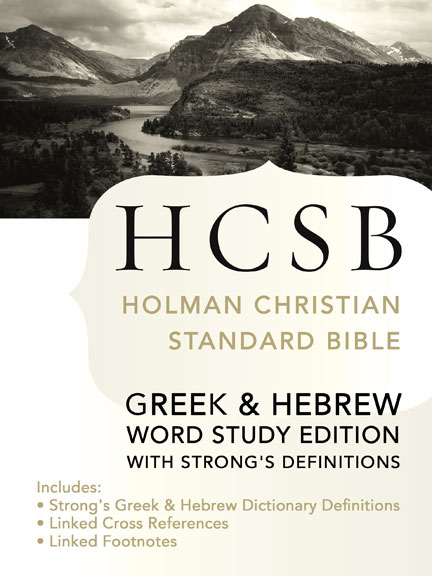
Trying Out the Holman Christian Standard Bible


When I first began reading the Bible in earnest, I used the NIV (New International Version).  The NIV is a very good translation.  It took a lot of criticism in the beginning, largely I believe, because it was such a break from the then tradition of biblical translation.  However, it’s been a number of decades and a lot of the KJV (King James Version) Only crowd have died off.  Many many more translations have been produced and the NIV has more or less fallen out of the popular spotlight though it is still quite popular.  Anyway, that’s the one I read at the time.  Using that Bible, I read through the New Testament a handful of times and the minor prophets and a few other Old Testament books here and there.

Then I heard about the ESV (English Standard Version).  It gained some sexiness in the mid 20-oughts.  Add to that, the Crossway covers (very sexy) and that was the first Bible I bought.  They had a free Kindle version too, which was nice.  Mark Driscoll also endorsed it along with a number of the Calvinist crowd.  But reading through the Bible, I started noticing some liberties being taken, especially in numerology.  People do complain about versions and the conversion of the word “man” to “people” but that’s not really what I’m after.  What I started noticing was that certain phrases or words were translated in ways other than the original text warranted.  It was things like in Exodus 20:6 where it says “showing steadfast love to thousands of those who love me.”  In the foot notes it says “or to the thousandth generation.”  A simple interpretation of a thought, yes, but when you mess with numbers in the Bible, you are missing with contextual meanings.  Can’t do that.  “Thousand” is used a number of times in the

Bible and specific meaning can be drawn from its usage. 

Compare the NIV:  but showing love to a thousand [generations] of those who love me.”

Compare the HCSB:  “but showing faithful love to a thousand [generations] of those who love Me.”

These make interpretations too, but they keep the terminology and they demonstrate what they’re doing while they’re doing it.  No footnotes.  Well, the NIV left out steadfast/faithful.
Another problem I have with many modern translations of the Bible is the traditional lack of translation of God’s personal name in the text.  Of course anybody reading the text knows that LORD means YHVH, the Hebrew transliteration of God’s name, so God’s name has not been “left out,” just left untranslated for tradition sake.  Virtually all scholars agree that the correct pronunciation of the tetragrammaton (four letter name) of God is Yahweh or Yah’weh.  But few translations of the Bible do.

So I started reading LORD as Yahweh in my own personal reading.  The thing is, the name is used A LOT, over 6000 times in the Old Testament.  But I was still reading the ESV, a version I knew had problems I didn’t like.

I had been told about the Holman Christian Standard Bible a while back by a Jehovah’s Witness or two.  They use the name Jehovah (a bastardized and Anglicized version of God’s name) profusely and stick it in everywhere in the OT and everywhere they feel it necessary to excise Jesus’ divinity in the New Testament.  Naturally, I distrusted anything coming from a JW.  They are after all perhaps the most well-known dangerous mind control cult.  But I came upon the HCSB on my own one day when researching the name Yahweh. 

The HCSB uses Yahweh when the name of God is stated in the Hebrew.  For instance, if the author says something like “our God, whose name is the LORD” it doesn’t really make much sense in English.  It’s like “they call me the Doctor!”  “Doctor who?”  “Exactly.”  Well, fun, but not useful.  It would seem to me a better translation would be “our God, whose name is Yahweh.”  Now you know what we’re talking about.

The HCSB still uses LORD pretty regularly.  They only use Yahweh a few more than one in ten times.  But remember, the name is in there over 6000 times.  That’s like eight times per page.
So after reading virtually all the Bible in NIV, and again in ESV, now I’m reading the HCSB.  Of course I still have access to every version available on various Bible apps, and my personal copies of the ESB, NIV, NASB, and even the Greek NT.  I can’t wait to get back to the New Testament to see how the HCSB translates those.

Tuesday, January 22, 2008

Calvinism vs. Arminianism and Why We Shouldn’t Pledge Allegiance to Stuff Like This.


I was talking to my friend’s girlfriend about the book “The Shack” by William P. Young, and she said she hadn’t read it because from what she had heard, she thought she’d disagree with at least some of its points. Of course she’ll probably be reading this at some point, so I’ll just say that she’s a very strong Calvinist, as is at least some of her family from what I’ve heard. She’s a very bright girl, and definitely believes what she says she believes, but I kind of get the feeling like she’s one of those brutal Calvinists, which is to say, those who see God as kind of hard and strict. At the very least, I’d like to introduce her to “kind Calvinism” as Mark Driscoll would call it. So, I decided what I’d do is just to go through both Calvinism and Arminianism and see what they both mean, and offer my insights on both.

For those of you who know me, you may know that I do not adhere to models, which is to say I am not an adherent to things with titles such as Calvinism, Arminianism, Trinitarianism, Arianism, Veganism, Conservatism, Liberalism, Preterism, Dispensationalism, Mormonism, Racism, Sexism, or most other isms excepting Monotheism. The reason is this: Formulaic models often glaze over truth in order to make a text agree with a presupposed belief. The tenets of some of those isms I do believe in, especially some more than others, but I would not say that I adhere to any of them because they are models, and I believe God as bigger than human doctrinal constructs. I do not believe that we can in any way confine or define God to single words whose meanings change with time. Like I said, I do believe in Monotheism, because I believe that eternally, infinitely, and unequivocally, there is only one God, and his singular singularity can be defined in our language by the word Monotheism.

Let me start by saying that this argument is entirely an in house argument. I mean that whether you are a Calvinist or Arminian, as long as you are a Jesus Freak, you are still ok with me, and I assume with Jesus as well. I’ll be quoting Wikipedia quite a bit as a source of definitions and for general information, and I won’t use quotation marks unless Wikipedia does because of the unknown authorship or the original article anyway. I’ll start with Arminianism which is still quite popular among popular and well known preachers and evangelists, and I’ll basically be stating each belief and my view on it, and why. It should be noted that Calvinism’s five points were created not by John Calvin himself, but later by people concerned with countering five points outlined at the Synod of Dort by Arminians. Arminius was born 4 years before Calvin died and died 100 years after Calvin was born. The Synod of Dort happened a year after Arminius died in 1609. In actuality, today Arminianism does not have five points anymore, and has reverted to what Jacobus Arminius believed which actually has a bit in common with Calvinism. Some may be actually surprised to learn that Calvinism and Arminianism are not directly opposed, but are like the two circles on a MasterCard. They have overlapping belief systems.

Arminianism

1. Humans are naturally unable to make any effort towards salvation.

I’d say true to a point, and that point being God’s call. However before the rabid Calvinists jump on that one, I believe that all are called just like the Bible says. In the literal sense, ALL are called. Jesus wishes all to be saved but naturally, many will not because they will not reciprocate his love.

2. Salvation is possible by grace alone.

Absolutely agree, however, it should be easy to spot believers and unbelievers based on speech and actions, not just what they say and do in public. I have known a number of worship leaders who said and did all sorts of things in public and wrote wonderful worship songs, but in private, to the discerning eye, they were at least questionable. So, salvation is by grace alone and is evidenced by love and works.

3. Works of human effort cannot cause or contribute to salvation

Yes, see above. This one belongs to Calvinism too.

4. God's election is conditional on faith in Jesus.

Election is a big big word in Calvinism, and this one can be taken several ways. Jesus said “I am the way, the truth and the life, and no one comes to the father but by me.” Salvation is certainly conditional on faith in Jesus, if you are a Christian, this one is probably pretty close to number one on the list of essentials. However, election is a touchy subject and since God knows the future, you have to decide whether He decides whether you have faith in Jesus, or whether you decide, or whether he draws you to decide, or completely outside any choice of your own, he gives you faith in Jesus. I think an infinitely Just God draws you and gives you a choice, I don't think it's "Duck, Duck, Damned."

5. Jesus' atonement was for all people.

Here’s another separation from Calvinism. One of the creeds says that Jesus sacrifice was once and for all. Though I don’t hold to any creeds, I agree with this. I believe that Jesus died for everyone, whether or not they chose to play that card at the judgment. I believe every sin committed in the history of the universe weighed on his shoulders on the cross.

6. God allows his grace to be resisted by those unwilling to believe.

Naturally. While humans may be unable to understand the pure infinity of knowing the future and yet not making it happen, I believe God can. In the same way, I believe God can create an entirely autonomous being with perfect free will, but not with infinite free will as God has. Of course God is all powerful and if he wished, he could cause anyone to do anything, but he doesn’t do anything as far as salvation goes that we do not want. He merely ratifies our choices, if we seek him, we will find him, if we choose not to seek him, then he merely ratifies our choice of damnation.

7. Salvation can be lost, as continued salvation is conditional upon continued faith

I do not agree with this in the sense that you can lose your salvation. I do believe you can leave it. I don’t believe that a person can get saved and then live out the rest of their life with no consideration of Jesus whatsoever and stay saved. I would submit that they never knew Jesus to begin with. God does know the end from the beginning, and he can see all the future, and if a person becomes backslidden or loses the faith for a while or multiple times but returns, God knew it would happen.

Calvinism is a bit different, perhaps more popular, and definitely more defined and structured, as a Calvinistic God would seem to be. Calvinism usually has five points, often denoted with the acronym TULIP. The five points were not created by Calvin, who more simply believed that God was in all things infinitely sovereign, but created in response to Arminius’ followers’, Remonstrants as they were called, 5 points. The Remonstrants actually opposed the doctrine of Total Depravity even though Arminius and Wesley affirmed it, but they just wanted to be opposed to Calvinism I guess.

Calvinism

1. Total depravity

This one is basically the same as #1 above.

2. Unconditional election asserts that God's choice from eternity of those whom he will bring to himself is not based on foreseen virtue, merit, or faith in those people. Rather, it is unconditionally grounded in God's mercy alone.

I would disagree based on the verse that says “those he foreknew, he also predestined.” Now what that means, I cannot say for sure. But I cannot accept the assertion that foreknew means something other than he knew before as I heard Driscoll put it today from last Sunday’s sermon. He said something like God reached out in love, and that’s what foreknew meant, but it is obvious to me that the word simply means that he knew ahead of time. I do believe the part of salvation being in God’s mercy alone, but with the context of God wanting to grant mercy to everyone. He would not have died if he did not want to grant mercy.

3. Limited atonement is the teaching that Jesus' substitutionary atonement was definite and certain in its design and accomplishment. Calvinists view the atonement as a penal substitution (that is, Jesus was punished in the place of sinners), and since, Calvinists argue, it would be unjust for God to pay the penalty for some people's sins and then still condemn them for those sins, all those whose sins were atoned for must necessarily be saved. Moreover, since in this scheme God knows precisely who the elect are and since only the elect will be saved, there is no requirement that Christ atone for sins in general, only for those of the elect.

This I mentioned up in the Arminianism section. Christ died for everyone; all sin was upon him. It leaves no room for question if anyone is elect or not, if you want Jesus, he is available. What if someone sneaks in who wasn’t elect? Then Jesus would have to go back and die again for that guy. I know it wouldn’t happen, but it serves to frame the argument. I don’t think injustice even enters the argument here for one simple reason. Jesus took upon himself our sin, there is no justice in that. There is mercy and love.

4. The doctrine of irresistible grace (also called "efficacious grace") asserts that the saving grace of God is effectually applied to those whom he has determined to save (that is, the elect) and, in God's timing, overcomes their resistance to obeying the call of the gospel, bringing them to a saving faith. The doctrine does not hold that every influence of God's Holy Spirit cannot be resisted but that the Holy Spirit is able to overcome all resistance and make his influence irresistible and effective. Thus, when God sovereignly purposes to save someone, that individual certainly will be saved.

I don’t really buy this because I don’t think God would directly save someone against his will. Heaven for a demon is like hell to a Jesus Freak. This goes back to the foreknowledge and predestination stuff. It would seem that God would look down in time, see those who would be saved with the right impetus, then provides that impetus. Of course, outside of that provision, no one would even want to be saved. I do believe that it is well within God’s power to overcome any resistance to his will, like he can overcome gravity or whatever, the simple question is “does he?”

5. Perseverance (or preservation) of the saints is also known as "eternal security." The doctrine asserts that, since God is sovereign and his will cannot be frustrated by humans or anything else, those whom God has called into communion with himself will continue in faith until the end. Those who apparently fall away either never had true faith to begin with or will return. This doctrine is slightly different from the Free Grace or "once saved, always saved" view advocated by some evangelicals in which, despite apostasy or unrepentant and habitual sin, the individual is truly saved if he or she had truly accepted Christ at any point in the past. In traditional Calvinist teaching, apostasy by such a person may be proof that they never were saved.

I am ok with this one as long as it does not include the “once saved, always saved” view. Again, God knows all future, and he knows if we fall away if we will return or not. My father is a pretty heavy Arminian and would ask the question if someone were saved and falls away, if they died while they were saved, would they go to heaven? I really think that is up to God, he knows the heart. I do believe God is irresistible when he wants to be, but he has purposed freedom of choice as a part of being created in his image. I believe he designed a perfect system in which his creations could choose Him or choose otherwise.

Calvinism as a kind of racism.

Something that bothers me about Calvinism is the whole election thing. It ends up being a kind of racism, something you are endowed by God with that makes you better than people who are not, just like white skin has for so much of history. The problem is, unlike being white, a person does not really know if they are elect. They never know if they may fall away at some future time and it turns out that they were never really saved at all. Even worse is when they argue with you. They can sometimes have an air of “I’m elect, and if you are arguing with me, you obviously aren’t.” I do not like classes, especially among believers. *I just thought of something after I posted this. Since you in reality don't really know if you are elect, that means you don't really know you are saved, and if you don't know that, then you are worse off than an Arminian who has assurance of salvation as long as he stays a believer. So pure Calvinism and Election both effectively remove assurance of salvation because you can't really know if you are elect unless you can read God's mind, and if you should happen not to be elect, then you are not saved no matter what you do. So instead of a salvation based on works where you don't know if you've done enough good in say Islam or Catholicism, you now have Salvation based on having faith that you will always be a believer, which is Arminianism. Did I just disprove Calvinism altogether? Interesting.

Overall, I must again stress that I do not hold onto models because they often need to play fast and loose with interpretation to make their stuff fit. The original Arminians simply came up with their five points to counter the prevailing Calvinism, and the Five Points of Calvinism were a response to the five points of the Synod of Dort Arminians. A belief system should never be made up of a list of things we don’t do or believe in, that’s not how Jesus worked. Jesus was all about the do’s. Care for the poor, forgive, be humble, love God, love others, have faith, be faithful, take heart, give generously, and believe in me were his commands.

So I’m like a two and a half point Calvinist, and a five and a half point Arminian.

WiredForStereo
Saturday, January 12, 2008

Review of “The Shack” by William P. Young


I just finished reading “The Shack” by William P. Young. You should know that as I begin to write this post it is 12:23 AM, and I’ve just spent about he last hour and a half finishing the last several chapters in the quiet of my office in the late evening. A bit of that time was spent weeping. For a time, I wept about once a page in the early parts of chapter 17. A bit of that time was also spent on my face on the floor weeping and praying, praising God, and all I could tell him was that he was good. My face is stiff from the salt in the tears, and my eyes and cheeks ache from crying, but it is an ache that I would not trade for anything. You see I know now that the God I worship is good. But more about that later.

The story is told by Willie, the author, he inserts himself in the story as a friend of Mack, Mackenzie Allen Philips. Mack’s daughter Missy was kidnapped on a camping trip while he was rescuing his son from drowning in a canoe. Evidence was later found in an abandoned shack in the woods that she had been brutally murdered. More than three years later, he receives an unstamped letter in the mail from someone named “Papa” inviting him back to the shack for a meeting. He decides to visit the Shack and what he finds changes his life forever.

That is my synopsis, it is similar to the one on the back of the book, and it really covers about four chapters of info that is important for the story, but less important for the truth contained within the story, which is what I want to talk about here.

First is the familiar term “Papa” which is used for God the Father principally by Nan, Mack’s wife. A well remembered name for the Father used in the bible is “Abba.” Abba is an equivalent to Dada or Papa depending on the language you speak. It is a term a very small child, perhaps barely speaking, might use to refer to his or her father. But let me ask this question, how many of us speak to our Heavenly Father in those terms? I think in all my (right) years, outside of people simply quoting the verse saying “Abba Father” I’ve only heard one person once call God “Daddy.” She is the very wonderful co-leader of our church youth group. And this brings such sadness to my heart, in the same way that verses in Psalms about singing and dancing with all your might and playing all sorts of instruments with all our might before the LORD are largely ignored in our contemporary church, as will most churches for the last millenniums. At least I have found a church where we can at least joke about it (“I guess we shouldn’t sing that song any more ;-). ”) All joking aside, it is a travesty that the God we love and worship, we cannot invite into our hearts far enough to be able to call him using a name which has a purely personal meaning. We evangelical Christians who believe in a personal relationship with God, largely do not live that out in our lives. It is not that I am criticizing the way we are, but begging that we change because we need so much to be embraced by Papa’s love, and that can be made more available, I believe, by using a name we might call our own father.

This book really does play with your mind, and it is meant to. Papa even explains that if he were to appear to Mack as someone who looked like Gandalf, it would serve only to reinforce his religious stereotypes. So Papa appeared as a large black woman named Elousia. The Holy Spirit appeared as a distinctly Asian woman named Sarayu, which apparently means “wind.” From what I can pick up in the book, she was difficult to look at, not because she was too bright or anything, but simply because she was difficult to see when looking right at her. She seemed to come and go as she pleased, appearing and disappearing at will but reminding Mack, that she had never disappeared at all, she was there all the time, and is everywhere all the time. Lastly, Jesus was portrayed as a slightly unhandsome average looking Middle Eastern man with a big nose, which Jesus was (likely big nosed and all.) There was much emphasis on Jesus being truly, fully and purely human, while at the same time being all that of God as well. I thought as I was reading that, logically speaking, if Jesus was a physical being when he ascended into heaven, then of course, he still is. He has not disappeared anywhere; he still is that way, up there somewhere. I believed it, but never really thought about it before.

Actually, I thought that way about much of the stuff in the book. Really, these things had never come to me in this way before, but I knew of them, and already believed them, but had never really understood them. It made God real to me in a way that he has never been real before. A major breakthrough for Mack, as it was for me, was that a huge gap created between us and God in our relationship with him is that we do not really believe that he is good. Sure, we say he is good, but deep down, most of us do not really believe that because all we can imagine of God is all our best traits to the nth degree, smashed together with all the goodness we can think of, with super powers, and God is not that way. God is in no way confined to our imaginations, because they don’t really exist, and God has no need to be a part of something that doesn’t even exist and never will. Therefore, we see things that we have decided are evil, and then judge God based on our own preexisting judgment. The truth is, the things around us are not ours to judge, to decide whether they are good or evil. Their inherent good or evil is in no way based on our perception of them. In the same way, if I look at a shiny piece of metal and say “That is obviously aluminum,” it has no bearing on what kind of metal it actually is, or even if it is a metal at all. Its essence and existence is entirely outside that of our own. Take that to the infinite power, God is the same way, which is why he says in the bible that his ways are not our ways, and his thoughts are not our thoughts.

A number of negative reviews that I have read have complained of the author doing something like creating God in his own image. I could not disagree more. God in this book is so much different from that. I think if you wanted to pare down everything he said in the entire book, it might fit into the sentence “I am nothing like you.” This is a God who cannot be predicted but can predict your every move, a God who is infinitely loving, caring, and patient and who affects change in your life. These things a human cannot do. So, no, no one made God in their image, they just stood well back and said “I still can’t see all of you Papa.”

One belief that this book specifically challenged was one of my basic beliefs about good and evil, or comfort and discomfort. When my wife and I were attending pre-marriage counseling, I told the pastor that I did not always want sunshine and roses, I was a kind of a realist, believing that you could not truly understand good unless you experienced bad. In a way, I believed that there could not be good unless there was bad, you know, to counteract it, to be the opposite of it. My belief has changed. It is the other way around. You cannot have bad unless you have good. Our infinitely good God came first. His light has always existed. His eternal good has always existed, and evil has not nor will ever overcome it because in the face of light, darkness flees. Darkness can no more resist light than I am able to come up with an apt comparison. By very nature, that is what it is, and what it does. Unimaginable distances of the pure black vacuum of space cannot erase the light of a single star. So, no, I don’t need to experience evil to truly understand what good is. Good is good, it is not confined or defined by evil, rather, like darkness to light, evil is confined and defined by good.

At one point in the story, Mack is directed to follow a trail which leads to a rock wall which he is miraculously able to walk through. Inside he finds a woman who is exceedingly beautiful, and whose words he would be happy to sit and listen to forever. We find out in the next chapter that she is Wisdom from Proverbs and that her name is Sophia, which is not a stretch since Sophia, is actually Greek for wisdom. Sophia is the one who tells Mack the way it is, not that God already hadn’t, but Mack had much to work through. Sophia told Mack that he had come to a judgment, and to his surprise, he was to be the judge. The catch was this. Mack had five children. Two of them would make it into heaven, and the other three were condemned. It was Mack’s job to decide which ones. Understandably, Mack was faced with a difficult choice, and as no father should be able, he was unable to choose which children would face condemnation, so he cried out and begged that he could take their place. We often think that God is some cosmic Judge Judy, going to sit behind a big desk on his throne and judge us for all we’ve done, and we have to find a way (Jesus) to avoid that. We end up loving Jesus, but not really loving our Father because of this misperception of him. What this part of the story says is that God no more wants to condemn us than we want to be condemned. He is our Papa, he created each and every one of us as his children, and his true love never wants us to leave him. That is why Jesus became sin for us, to take our place, because Papa loved us so much, he wanted to save us, and would sacrifice himself more than willingly to redeem us from our independent streak.

This leads to another point. Some I’ve talked to seem to catch a hint of Universalism or something in this book, but they miss what Papa says about relationships, they are a two way street. God can do all the loving in the world, he can reach out, he can perform miracles, he can redeem us from our sin, but he can never nor will never force us to come to him. That is what true relationship is, it is expectancy, not expectation. Expectations leave us hurting when they are not fulfilled, but if we live in expectancy, just waiting to see what wonderful things might happen between us, then there is no hurt, only joy.

One of the most wonderful things about this book was how it treats evil, and what happens when God works through evil to affect the best in the world. Throughout the book, Mack is overcome by what he calls “The Great Sadness,” a darkness shrouding his heart after his daughter Missy was kidnapped and murdered. Mark Driscoll of Mars Hill Church in Seattle was talking about Calvinism and mentioned a woman he knew who had been raped who was a staunch Calvinist. She asked him “Why did God have me raped?” A similar question was asked in “The Shack.” Mack asked if his daughter was murdered so that he could be rescued as it were. God made it clear that it is not he who causes evil to happen though he is able to work good through it. This kind of human thinking causes us to be able to sacrifice a few to save many, where God’s way of doing things sacrifices only one, himself. God never works any kind of evil, and it is never in his purpose for any sort of evil to happen, what God does is to work through evil, our choices and independence from him to make good things happen for his purpose. God would never have anyone raped, or murdered, or anything else to bring about anything, no matter how good the ultimate result would be. He uses evil for good, he does not cause evil to happen.

Another complaint I’ve heard, is that Satan and his power is conspicuously absent. In fact, as I remember, Satan is not mentioned once. I don’t have a problem with this. I don’t think this is a story about Satan, I think it is a story about God’s love. It is a parable. In the same way that the parables of Jesus do not mention Satan, neither does this one because there is a specific point to be made, a hurt to be healed, and Satan is not needed to convey the love of our Father toward us. I think the only nod to Satan in this book is when one of the characters says that all sin is a result of the desire for independence from God, and that certainly fits Lucifer as much as it does us. The point of this story is to release people from sadness and anger toward God, and to show that Papa really is good, and as I mentioned before, we don’t need evil to show what good is, it is the other way around.

In conclusion, I strongly recommend reading this book, many have said that it is the most impactful book they have ever read beside the Bible, and I would tend to agree. Whether or not we know it, I think we all need the kind of healing Mack received, because we all tend to hold grudges against God whether or not we know it. We don’t understand God and in our limited human understanding, we hold that against him. We need to know him personally to understand him, all the rules we put upon ourselves do nothing to bring us closer to him unless we can realize that we are powerless to follow those rules. And that’s what the rules are for.

I dare to call him Papa,

WiredForStereo