I ended up reading 17 books in 2017, up from 9 last year, but way less than my record of 38. Would have read way more if not for listening to so many Richard Rohr retreats and lectures. Also, my podcast load is too heavy, but there are so many good ones. So let me just give you the titles and authors and a brief description and you can decide whether or not you want to read. And I listened to most of the audiobooks in the Harry Potter series again this year on family trips, but I already listened to those before, so I didn't really count them again.
I find my best method of intake is audiobooks which can get expensive, but gets cheaper when you use a subscription service with Audible. You can certainly save bucks over the list price. Whenever you have the chance, buy credits. You should never have to pay more than $15 for a book or lecture series. I also read some Kindle books as I can read those laying in bed before going to sleep. And also in December, I began celebrating a Sabbath every week, for which I bought my first paper book in several years.
These are generally in the order of which I finished them, but may not be exactly. I often read books overlapping, like right now, I'm on one audiobook, one paper book, and one Kindle book, all at the same time, and they may finish one before another or overlapping and whatever. I realize not everybody can read three books at once! But I do it because I read books in three different ways, audiobooks for while I'm driving or doing manual work, electronic for in the dark, and paper for Sabbath when we shut off electronics.
The Life Changing Magic of Tidying Up Marie Kondo Audiobook
I don't know why I bought this book. It was pretty good, written from a Japanese perspective, helped me to grasp the idea that stuff and junk shouldn't be in my life if it isn't giving me joy or usefulness.
How I slept My Way to the Middle Kevin Pollack, Alan Goldsher Audiobook by the author
I've always liked Kevin's standup, and excellent impressions. This book was really enjoyable for its backstories of film projects Kevin has been in, and gave me some films to add to my Netflix list. The best part of this book is the impressions by Kevin.
True Porn Clerk Stories Ali Davis Audiobook
You might assume this book is more salacious than it is, and it has its moments, but it is a nice little memoir with some really good stories about being a video store clerk. And it is a video store, not specifically a porn store. I listened to this on the drive back from Arizona in the late winter. That's the best time to be in the desert, I think, I've done it twice. Lovely weather compared to Oregon that time of year.
The Subtle Art of Not Giving a Fuck Mark Manson
Listened to this on the plane rides back from somewhere on my beekeeping speaking adventures. A good motivational book. Basically the idea is similar to "say no to unimportant stuff so you can say yes to important stuff."
Revolution for Dummies Bassem Youssef Audiobook by the author
Bassem has always been an interesting character for me since I first saw him on the Daily Show. This book chronicles the world he came from in Egypt. Always get audiobooks read by the author, they are so much better, except for Harry Potter, I'm sure Jo Rowling couldn't do as good with the voices as the guy who does them.
What is the Bible? Rob Bell Audiobook by the author
As a long time fan of Rob, there was no way I was not reading this. True to his style, this book explores the Bible, though I would have liked it to be much longer, it is quite good.
The Divine Dance Richard Rohr Audiobook
This is Richard's recent book on the Trinity. I listened to this driving back from picking up a trailer in Oklahoma when I started my current business this summer. Small problem, I was super depressed and having a cruddy time. Basically my thought through the entire thing was "this sounds so awesome, but is any of it true?" So I'm going to have to go back and listen to it again because I was in no frame of mind.
The Disaster Artist Greg Sestero, Tom Bissell Audiobook by the author
If you have seen The Room, you have to read this book. It's the story of Greg and how he met Tommy Wiseau. What really livens it up is his dead on impression of Tommy which is used extensively. Tip: Set Audible speed to 1.25x because Greg reads REALLY slowly. I often run the speed up a bit simply because I have a higher processing speed. Not always with Richard Rohr's books though because they are meaty and require more processing power.
Writing My Wrongs Shaka Sengor Audiobook by the author
A really good book that gives you a look at what it looks like to grow up in a drug and gang rich environment, from a man who spent nearly two decades in prison. Narrated by the author, the richness of the local accent is brought out. Mr. Sengor is not a professional narrator, so he lacks in dynamic and emotional range, but still good.
The Sin of Certainty Peter Enns Audiobook
This book literally resurrected me from the crushing depths of depression and anxiety. Seriously, in the morning I could hardly get out of bed and by evening, I was fully normal. It was amazing. The overall message is that God wants trust rather than correct belief. Must read for those in deconstruction, reconstruction, post-evangelical, etc.
Falling Upward Richard Rohr Audiobook by the author
Recommended to me by a good friend, this book is about Richard's two halves of life. It will help you learn a lot about yourself, where you are, and where you are going, and help push you along the path. Excellent book. Top 5 Rohr books.
Sober Stick Figure Amber Tozer Read by the Author
I don't remember why I got this one. I think it was because she is a comedy writer, or maybe it was on sale, or I don't know. But it really helped me to scrub my ignorance about alcoholism by telling the whole story from beginning to present. It helped me to understand a friend who is a former alcoholic, and other authors like Nadia Bolz-Weber who is also a former alcholic. Listened to this on a drive to Seattle and back.
Yes, My Accent is Real Kunal Nayyar Read by the Author
Also on the Seattle trip, I listened to this book which is entertaining and enjoyable. Not on the top of the list of profound and spiritual books, but enjoyable.
Lies We Believe About God Wm. Paul Young Read by the Author
Another author I read everything from. Paul wrote "The Shack" and some good stuff since then. If you have trouble with God, read Paul Young's books. He's worked through it and has an amazing way of feeling about the world. Listened to mostly in a hot tub in Missouri.
The Evolution of Adam Peter Enns Kindle
I bought this a while back and forgot to read it. It's a touch drier than the other one above, but if you want to hear about ancient near east history and biblical history, it's chock full of it, and I do, so I was happy. What I didn't care so much about was all the arguments why the story of Creation doesn't need to be read literally which was a point I had already moved past in my journey. But if you are in that point on your journey, it is very helpful. Like often happens in Enns books, there was quite a bit of "good to know" stuff in the history part and quite a few "huh, didn't think about it that way" in the theology parts.
Breathing Underwater Richard Rohr Audiobook
Another book relating to alcoholism, this book was jam packed with mind blowing material. Top three Rohr books. It explores the connections to spirituality through the 12 Steps, step by step. As you can tell, Richard is blowing my mind a lot lately, helping to form my spirituality. At this writing I am reading a paper book, a Kindle book, and in the midst of a lecture series on Paul all at once.
The Idolatry of God Peter Rollins Read by the Author
I bought this a while back but never read it because I was kind of hesitant to read it because Rollins likes to burn things down (his "Pyrotheology") and I didn't need that at the time. There were a few of his arguments I didn't buy, but overall, he had a lot of good stuff to say, not about filling the God shaped hole, but about getting out of the God shaped hole paradigm. Speed this one up a little, and I hope you like accents, because Peter Rollins is Irish as hell.
Well, there you go. And remember, half the country doesn't read books at all. I know quite a number of people who have never read a book after they got out of school. Stones are for sharpening swords, books are for sharpening minds. Who knows where I'd be navigating my depression without good books to read. Major lesson I learned this year, you can't have a resurrection without dying first. There is no meaningful growth that results from success, but only from failure and pain.
Happy New Year
Solomon
Showing posts with label Book Review. Show all posts
Showing posts with label Book Review. Show all posts
Monday, January 1, 2018


Sunday, February 10, 2013
Book Review: Cross Roads

Some time ago, I read and reviewed The Shack written by W. Paul Young. I was blessed that he found my review and left a comment. I hope he does again, but if not, oh well. He’s a bit busier now that he is a famous published author probably.
I just finished reading Cross Roads last night. Like The Shack, it did not disappoint in enlightenment, and offered some new weirdness.
Don’t get me wrong, weirdness is not bad. I like weirdness. But there was quite a bit of weirdness.
While The Shack offered an experience akin to an expository dream, Crossroads delves more into the realm of spiritual fantasy. The main character Tony spends a good deal of time knocking about in other people’s minds, not just as a silent passenger, but as an active participant in their stories.
As Mr. Young seems to be able to do, this book brought tears to my eyes on several occasions. Once or twice, I wept silently in my bed in the dark where I do most of my reading. He very effectively presents a redemption story, though a worse human being I have rarely heard of. Short of murder and rape, this guy was a really bad guy. Imagine remarrying your ex-wife just so you can divorce her again, stick it in her face, and have the police escort her and your children from your own house which you bought out from under her while throwing her a get the hell out party. This dude was mean. There are other things that I consider even worse, but which I won’t tell you here because it’s a bit of a plot point. He was a bad guy.
But when he suffers an accident and is laying on his death bed, his journey of redemption and salvation begins. It’s the journey of a wicked and broken man finding out that God still loves him no matter how horrible he is.
Paul Young introduces us to Jesus and the Holy Spirit again though this time around the Holy Spirit takes the form of a different woman, a Native American. Papa God doesn’t appear personally, but his presence is felt and spoken of thought Tony’s adventures while his body lay dying.
Jesus and the Holy Spirit live in a land through which Tony travels. Jesus has a run down house and Grandmother (as she is called) lives in a “hovel” which is small and sparsely furnished. But she’s still a good cook. What these homes are supposed to represent is the space in our hearts, the space for which we have provided room for God. I imagine in some spiritual giant’s heart, the homes would be large, well kept, and lavish. But in Tony’s (an effective atheist) heart, only small homes were provided.
Like Paul Young’s last offering, this book provides a resource in dealing with loss. The honest truth about the Bible is that it doesn’t offer much effective therapy for those grieving a loved one, whether that grief be due to death, disease, defect, or defection. We mourn for those who we loved who have died, but we also mourn for those who are taken from us for some other reason, maybe Down’s Syndrome or some other genetic disorder which robs us of our full mental capacity. A parent mourns for the lost opportunities, for lost baseball games, for lost report cards, for lost first words and first steps. And honestly, the Bible doesn’t help us much with those. But sometimes we meet a person who is much more in tune with how to deal with grief, and usually it's because they have grieved. Paul Young is one such person in my eyes.
The overarching message of The Shack to me was “God’s ways are not our ways.” For this book, I’d say it’s something like “I will never leave you.” God is there to comfort, share pain, to love you and to hug you. And he wants to redeem you always. You’ll never reach a point where God gives up on you and leaves you completely even if you push him out completely. He still wants you and he’ll always come back if you’ll have him. Like Mr. Young said in The Shack, God is not just a better version of you.
I really enjoyed this book. I recommend it to anyone. Maybe it won’t keep you glued from the first page to the last and maybe it will, but it tells a story and the story has a lot of feeling and emotion and even meaning. I hope you enjoy it too.
9/10
Friday, March 2, 2012
Writing versus Reading
Just got done with a year long binge of reading. Yeah, reading, not cocaine, not porn, not watching the entire run of Weeds. Well, I did the Weeds thing, how could I not. I'm from the West Coast right?
As you've seen, not much writing has been getting done around here. And it's probably because of all the reading. Apparently, I can't read and write at the same time. Let me clue you in to the monumental task that it is to keep my considerable intellect occupied.
In the last year, I read:
The Lord of the Rings
Dune
Dune Messiah
Children of Dune
God Emperor of Dune
Heretics of Dune
Chapterhouse: Dune
Speaking of Jesus by Carl Madearis
The Next Christians by Gabe Lyons.
Love Wins by Rob Bell
Sex, Mom and God by Frank Shaeffer and that rounds out back to about March at which point it gets a little fuzzy.
Before that, I read Crazy for God by Frank Shaeffer, Rebooting the American Dream by Thom Hartmann, They like Jesus but not the Church by Dan Kimball, and When Christians Get it Wrong by Adam Hamilton. That goes back to when I got Kindle for iPhone in the early part of the year.
If that weren't enough, after Lord of the Rings, I read:
The Hobbit
The Rapture Exposed
Liespotting
Pornland
Fuse of Armageddon
And I'm currently working on Wind Power by Paul Gipe, but that's for class. I'd read it anyway.
That's a year's reading for me. I read more books in the last year than many people read in their entire life. If you're wondering which books to read, I don't often finish a book if I don't like it. You could read any of these and find them stimulating
But I think I'm going to start writing again. I've already been working on my beekeeping website. It's my own personal encyclopedia of beekeeping. Check it out at parkerfarms.biz. I also have a beekeeping blog at parkerfarms.blogspot.com.
I'm still looking for ideas, though I have plenty of fodder in politics. I like hypocrisy especially. Not to watch it, to criticize it.
I am,
WiredForStereo
@wiredforstereo on Twitter too.
As you've seen, not much writing has been getting done around here. And it's probably because of all the reading. Apparently, I can't read and write at the same time. Let me clue you in to the monumental task that it is to keep my considerable intellect occupied.
In the last year, I read:
The Lord of the Rings
Dune
Dune Messiah
Children of Dune
God Emperor of Dune
Heretics of Dune
Chapterhouse: Dune
Speaking of Jesus by Carl Madearis
The Next Christians by Gabe Lyons.
Love Wins by Rob Bell
Sex, Mom and God by Frank Shaeffer and that rounds out back to about March at which point it gets a little fuzzy.
Before that, I read Crazy for God by Frank Shaeffer, Rebooting the American Dream by Thom Hartmann, They like Jesus but not the Church by Dan Kimball, and When Christians Get it Wrong by Adam Hamilton. That goes back to when I got Kindle for iPhone in the early part of the year.
If that weren't enough, after Lord of the Rings, I read:
The Hobbit
The Rapture Exposed
Liespotting
Pornland
Fuse of Armageddon
And I'm currently working on Wind Power by Paul Gipe, but that's for class. I'd read it anyway.
That's a year's reading for me. I read more books in the last year than many people read in their entire life. If you're wondering which books to read, I don't often finish a book if I don't like it. You could read any of these and find them stimulating
But I think I'm going to start writing again. I've already been working on my beekeeping website. It's my own personal encyclopedia of beekeeping. Check it out at parkerfarms.biz. I also have a beekeeping blog at parkerfarms.blogspot.com.
I'm still looking for ideas, though I have plenty of fodder in politics. I like hypocrisy especially. Not to watch it, to criticize it.
I am,
WiredForStereo
@wiredforstereo on Twitter too.
Wednesday, February 22, 2012
Book Review: Fuse of Armageddon

In modern apocalyptic fiction, there is but one name known throughout the world, Left Behind. It is a novelized account of what will happen when the beast of Revelation shows up and decides to do his work. But it's terrible. Popular among the young and impressionable evangelical conservatives, but to any discerning reader, just terrible. The plot lines are thin, convoluted, completely lacking in reality or human condition and at some points, patently bogus. Like the part where as soon as the conservative Christians are raptured away, the world goes to heck in a rocket sled and just signs the whole planet over to the 'antichrist.' Like liberals could ever agree on anything. I put 'antichrist' in quotes because of how horribly they misuse the term. Nowhere in the Bible is mentioned "the antichrist." In the few places it does appear, it's "an antichrist" or "of antichrist." The antichrist is not a single person, but anyone with a certain attitude or ambition.
I digress.
Anyway, Sigmund Brouwer and Hank Hanegraaff started their own series which is the partial-preterist answer to the Left Behind series. It's called "The Last Disciple." Instead of showing a future plot line, it is historical fiction as what John was talking about took place during the decade or so before the fall of the Temple in 70 AD. The wrote the first two books and then took a break to write "Fuse of Armageddon." Fuse is a tomorrow sort of book where you get the idea that the lead up to the climax of the book is taking place right now. In novel form, it shows what could happen if dispensational eschatologists took their beliefs to ultimate fruition and tried to bring about Armageddon by sacrificing a red heifer and cleansing the temple mount with its ashes. It shows what could happen if radical christian Zionists get their hands on the controls.
Mr. Brouwer as the novelist is the analog to Jerry Jenkins, the novelist of the LB series, and Mr. Hanegraaff is the theologian behind the story the same as Tim LaHaye. The prime difference is, Brouwer and Hanegraaff write things that could actually happen. Their characters say things people would actually say and they do things people might actually do. Their characters are smart and there's no spiritual heeby jeeby nonsense going on to finagle things in to fitting the biblical narrative counter to the way real people actually do things.
In all my exploration of theology and eschatology, the partial preterist viewpoint is the only one that has ever made sense to me. And it doesn't rely on doing grammatical douchebaggery to make everything fit together like a jigsaw puzzle of a beautiful sunset which ends up being a mustard stain on a pair of mechanic's overalls. It fits together and it makes sense and all you have to do is take the literal things literally and the apocalyptic things apocalyptically. Also throw in a bit of 'tradition is slightly mistaken about when certain things happened.' I'm always a sucker for getting rid of outmoded traditions. It works because it makes sense for real people who said these things, who heard these things, and who did these things.
Being told that Armageddon was going to happen in 1997 is tantamount to child abuse in my view. Hope you had a better childhood. That's all I got to say about that.
The only trouble I have with this book is something that was a terrible aspect of the Left Behind series, portraying the other side. How do you write dialog for an argument for which one side is your side? When should the opposing side be left dumbfounded? How weak should the opposing side's arguments be? The Left Behind series portrayed the other side exactly as they saw the other side, the trouble is, that's not how the other side is. Brouwer and Hanegraaff do a much better job as far as I can see it, but it's still not perfect. What is perfect? I don't know. I'm on their side. I've never believed the stuff on the other side. Sometimes you genuinely try to show what the other side believes, and sometimes you're just pushing propaganda. Walk that line. These guys don't push the agenda too hard, it's just part of the facts of the story. In the end, the televangelist doesn't just magically switch sides on the issue, he thoughtfully admits that maybe his view isn't the only one, and that's something enlightenment does to real people.
Overall, I enjoyed this book. I love the way Brouwer interweaves his plot lines, telling each story in little snippets and moving back and forth between them right at the most suspenseful moments. I read this book pretty rapidly and would have read it faster had I had more time. I give it 9/10, for the message and for the story.
I will be reading the next book in the Last Disciple series, it's coming out later this year and will be called "The Last Temple."
Thursday, September 9, 2010
Book Review: "Patience with God: Faith for People who Don't Like Religion {or Atheism}" by Frank Schaeffer
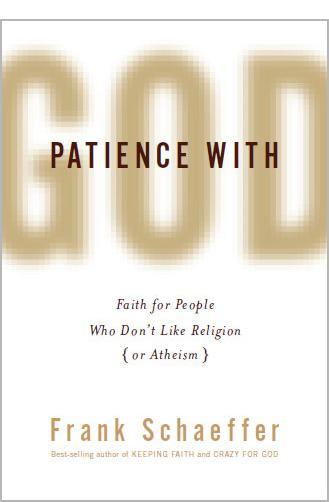
Later in the book where he focuses more on his backstory and history and philosophy, the salient points are further between, but Frank is a good writer, and if he doesn't expand your vocabulary, you're probably an english major. Unlike other books where I feel like the author was writing to a ninth grader, Frank keeps it more up to my level.
I heartily recommend this book especially if like me, you're searching for not just something to believe in but the best and most truthful something to believe in. And I don't mean truth in a "We have the truth, join us" sort of way, but a level headed look at the real factual truth, the truth that God is not the god of the fundamentalists, or the right wing, but the creator and redeemer of our planet.
I don't recommend reading Schaeffer's book to believe everything that's in it, but rather to read it to glean information and ideas from it. Schaeffer takes an even more liberal and cynical view of religion than I do, and if you read his Huffington Post articles, you'll find that. At times he can even be a bit overly hostile especially toward the Older Testament. But he has a very interesing and eye opening point of view.
If you plan to read this book, I suggest you read "Crazy for God" first as this book may seem to build upon it in a few places. They were written in that order, so it only makes sense to read them in that order.
9/10
WiredForStereo
Wednesday, August 11, 2010
Book Review: Crazy for God: How I Grew Up as One of the Elect, Helped Found the Religious Right, and Lived to Take All (or Almost All) of It Back by Frank Shaeffer

In the last few days, I've been reading this very interesting book. I had seen Frank Shaeffer several times on shows like Rachel Maddow and on YouTube. I was very interested in his points of view considering that he is a left leaning Christian, I guess you could say.
I was even more intrigued when I learned about his past, how he was the son of the late great evangelical theologian Francis Shaeffer, though after reading this book, he might just be late, but everyone has their flaws. The subtitle really explains a lot. Frank was the one or one of the main ones who brought the abortion issue into the mainstream conservative religious right playbook.
Frank grew up in Switzerland, the child of two evangelical royalty as he calls them. Of the many things I learned from this book was a couple of ways how not to raise your children. Frank was for most of his childhood given the run of the land and little education. It also didn't help that he had dyslexia.
He doesn't hide much, talking about how controlling, hyperspiritualized, and condescending his mother was, and how abusive his father was toward his mother. He also tells about his own inheritance of these traits, how mean he was to his wife and children. He also tells how his parents were uncommonly kind and understanding to people commonly rejected outright by the contemporary American church. There don't seem to be any subjects that Frank doesn't cover, including masturbation, spousal abuse, and a crush he had on a star of one of his movies.
He talks about his abandoned art career, his successful professional Christian career, his failed movie director career, and finally his success and contentment as an author and conversion to the Greek Orthodox church.
Most interesting was the inner workings for the christian right movement which has taken political power for the past few decades. It was very interesting to learn the history, the behind the scenes wrangling, attitudes, and control.
I would recommend this book to anyone. It's the real life story of real life people whose fingerprints on society have shaped history for decades and will continue to do so for the foreseeable future. This book gets pretty real, there's swearing, there's sex, there's yelling, and there's the behind the scenes lives of revered people. 9/10.
WiredForStereo
Thursday, September 17, 2009
Book Review: "Crazy Love: Overwhelmed by a Relentless God" by Francis Chan

I just finished reading (listening to) Francis Chan's Crazy Love. I downloaded the audio book read by the author from iTunes and it's a good listen at about four and a half hours. It cost about two bucks less than buying it, plus there wasn't the hassle of needing to leave the house or paying taxes or burning gas to go somewhere to pay too much for it at the local Christian bookstore (no names.)
The first three chapters of the book are kind of a foundation for what the whole book is about. I woke up a little sick this morning and decided to take a long hot bath as I often do when I'm sick. So between last night and the bath, I listened to about the first four or five chapters. Apparently I stayed too long in the bath because I got out and threw up all the grape juice I had been drinking. The first chapters left me with a feeling of "yes I know that." He was talking about how great God is and how much he loves us and how the story of the universe is really about him and not us. Very important stuff. One point that struck me was about our relationship with Jesus and how we should seek that first. He quotes statistics about how most Christians pray only a couple of minutes a day and watch TV for four hours.
But later on came the real good stuff. You know the kind of stuff that you sit and listen to (or read) and you know in your soul that what is being said is the truth and that all these years I have been making excuses for not taking certain parts of what Jesus said literally. I was sitting in the Civil Engineering lounge in Bell doing my homework and listening to the meat of the book and I started to cry. I have always lived in marginal houses and have always wanted to build my ultimate dream house, an earth sheltered ultra efficient super sustainable house that would have virtually no utility bills and would be the paragon of virtue in a green world. But I realized that if I were going to follow Jesus and give what he wants me to give, I don't think I'm ever gonna get my house. I'll never be able to fulfill many of the dreams I've had growing up the way I did. I already know I'm not going to be rich and I'm okay with that. But will I ever get to live in an efficient house? Will I ever ever get to own an electric car? Do I get to see my dreams come to fruition?
I want to be a Christian, I want to be a disciple of Jesus, but the question is, what will he ask of me? And when will I have to tell my wife about it? How much do I give? How much is enough? Can there be too much?
I want to do what is required of me, but I don't want to do the minimum. And my flesh tells me I certainly don't want to do the maximum. I don't want to go the Financial Peace way and simply save my way into financial security, that's not what Jesus calls us to do.
Francis goes through a near comprehensive list of what it is to be a lukewarm Christian. He says there won't be any lukewarm Christians in Heaven. I recently encountered a lukewarm Christian or two when they demanded that I prove my care for the poor by telling them everything I had done for the poor. And as he read through the list, I thought, I do more than all of those, I give more money, I give more time, I serve more, I'm less demanding, I'm less worldly, but in the end, what is enough? What on God's green earth am I supposed to do exactly? What do I do?
Much of the last half of the book I spent waiting for the punchline. I waited for Francis to tell me what it was that I was supposed to do to fulfill God's will. Was I supposed to sell my house? Am I supposed to give all my possessions to the poor? What do you want Francis, I'll do it!!! If you tell me to sell my house I'll do it. If you tell me to be a nominal Christian and give sparingly to missions, I'll do it, just tell me. Neither poverty nor riches, I'll do it. Do you want me to save up and retire early so I can be a volunteer at my church for the rest of my life? Do you want me to move into the city... never mind, I don't want to do that. But anything else Francis, I'll do it. How is my life supposed to be? I don't want to just do enough so I don't feel guilty anymore. I have enough guilt already.
However, in typical fashion in nearly all Christian books, Francis didn't tell me what to do. He did give me a few examples though, including Shane Claiborne and Rich Mullins (though I would like to remind everyone that Rich would probably still be with us if he'd been wearing his seat belt.) And they are great examples, even Shane is a real Christian Greenie like me, but he doesn't get to live in a super insulated house either. He lives in the city and plants trees in toxic waste sites and feeds poor people.
Lately I've been coming to the conclusion that I'm not supposed to be a goer, but a sender. I like that, it's comfortable, it's nice, it doesn't require me to step out on a limb or be adventurous or anything, and maybe I might get a foundation or a building or something named after me. WHAT THE HELL AM I SAYING?!? Actually, just skip the second sentence in this paragraph, it was entirely untrue and only said to make a point, I've never felt that way. But now, I'm wondering what I really am supposed to do. I'm left with the last thing God definitely told me to do and that was to become a Civil Engineer. He hasn't really told me anything since then, not that I haven't asked him to, but we haven't really been close lately in all honesty.
Am I supposed to live on my engineer's salary? Do I drive that electric car? Do I build that house? Do I do short term missions like my Hydraulics professor, you know the one I wanna be like when I grow up? The big question is, did God make me with the inborn desires that I have, the car, the house, the wind turbines, the third world water filters, or are these my way of trying to slip into the file cabinet of "just above mediocrity?" Should I really have been crying about not being able to have the house? And it's not just the house, do I really have to give up all that I want to do with my life? Should I sell my $110,000 house and buy a $55,000 house and give the rest to the poor? I already live in a house that's a square foot and a half bigger than exactly half the size of the average American house, how much further down do I need to go? Can I build a 600 square foot really efficient house to house my wife and future four to five children (two adopted?) Can I have an electric car or can I convert my 24 year old mini pickup to electric and use that? Or should I sell my cars and ride my bicycle the nine miles into town? Or should I sell my house and live in a 600 square foot apartment in town? Do I sell everything, give it to the poor, live in my truck and have my wife leave me? Am I supposed to keep blogging, can God use that?
GOD TELL ME WHAT YOU WANT ME TO DO AND I'LL DO IT!!!
Fantastic book, I give it 10/10. Read it, if it doesn't change your life, you should really think about shooting yourself because you're just wasting your time anyway. $5.95 on iTunes.
WiredForStereo
Saturday, May 17, 2008
Review of “Jim & Casper Go to Church” by Jim Henderson and Matt Casper.

WiredForStereo
Friday, February 15, 2008
Answers to Some Concerns About "The Shack"
After "Anonymous" posted me some some comments on my review of "The Shack" by William P. Young, I decided to do a little more in depth research on the book. I had done just a little before, listening to the criticisms of my friends and and some of the pastoral staff (also friends) at my church. I had read a few negative reviews and entertained a few thoughts of what some Calvinists have said, have been told what an Arminian book it is, and as with any book, weighed all the information in my mind.
So I went perusing the internet with my trusty tool and sponsor Google because of some of the info I had found on my web tracker. Some of the people who search for reviews of The Shack also are searching for words like Sarayu and Elousia. Since I had not yet looked up the meanings of these words as I often do, I decided to do just that and was interested at what I found. First I found the criticisms of the book which I will enumerate some of as I define the words. Second, I found out what the words really meant, and their usage throughout history, which I will also explain.
Let's go.
Elousia, if you do a quick search, you will find out is Greek for tenderness. It is also the title of a Catholic icon depicting the Madonna and the baby Jesus. Critics jump all over this saying that Mr. Young is trying to sneak in some Marianism, attempting to water down God by inserting Mary. I find this interesting because it would seem to me that a book attempting to plead the case of a merciful and good God might use a name that reveals just that. We must go back to the definition of the word, tenderness. This is a trait that the God of The Shack is soaked in.
In my experience it is good to look at overall messages of a book. One thing that I have tried to do is to never read a Bible verse as Greg Koukl puts it. That means never read just one verse, not never read any verses. The technique seeks to achieve understanding of the context of a work, and not to take anything out of context. For the most part, The Shack espouses the classical view of the Trinity if you can get past the temporal physical manifestations of the normally only spiritual components of the Trinity. That is to say that the Father and Spirit appear as women, and if you can get past that, you see the classical view of the Trinity. Now you must understand one thing: Cults and heretics never never usually never espouse the classical view of the Trinity. It is often the first thing to go, and yet it appears in this book, a controversial work of symbolic fiction.
The next subject has earned The Shack and accusation of being a subversive work of Hinduism. In the book, the Holy Spirit is depicted as an Asian woman named Sarayu. Sarayu is a Sanskrit word meaning "to flow" and also wind, air, or that which streams. It is a tributary of the Ganges in India. It played a role in some great Hindu stories and myths and is mentioned in the Rigveda. Anyway, some say this means that the book is a Hindu work or at best has a message of universalism. Again we must simply look at the word itself. It means wind, just as the book says. That's all there is to it. Spirit in Greek means breath. It's the same thing.
This whole thing brings two things to mind. First, I have not found any criticisms of the character of Sophia, wisdom personified. This may be because it is a Christian concept as well as being a pagan and gnostic one. But that's the kicker, if it wasn't a Christian concept, would Mr. Young then be accused of Neoplatonic Hellenism? Though wisdom personified as a woman is a central figure in Proverbs, the concept of Sophia is much older than Christianity, Plato taught about it as well as did others. Sophia in Greek is of course wisdom, that much should be obvious by now since we are discussing the meaning of words.
But that leads me to my final point about these kinds of criticisms. If you are to subject a work of fiction to this kind of rigorous test, why not the Bible? John makes copious use of the word "word" in John. Logos (in Greek) appears as much as five centuries before the time of Christ in Greek philosophy and religion, and John has the stones to actually ascribe these pagan attributes to Jesus Christ himself!!! See what I mean? It is ridiculous for a Christian to criticize a book for word choice when the Bible uses the very same cultural references. Christianity has always done this in an attempt to reach out to the intellectuals of its day. It always will.
The Spirit is fluid, a wind, a breath, and it will get into every crack and crevice of every culture and make itself known. And sometimes it will use words.
WiredForStereo
So I went perusing the internet with my trusty tool and sponsor Google because of some of the info I had found on my web tracker. Some of the people who search for reviews of The Shack also are searching for words like Sarayu and Elousia. Since I had not yet looked up the meanings of these words as I often do, I decided to do just that and was interested at what I found. First I found the criticisms of the book which I will enumerate some of as I define the words. Second, I found out what the words really meant, and their usage throughout history, which I will also explain.
Let's go.
Elousia, if you do a quick search, you will find out is Greek for tenderness. It is also the title of a Catholic icon depicting the Madonna and the baby Jesus. Critics jump all over this saying that Mr. Young is trying to sneak in some Marianism, attempting to water down God by inserting Mary. I find this interesting because it would seem to me that a book attempting to plead the case of a merciful and good God might use a name that reveals just that. We must go back to the definition of the word, tenderness. This is a trait that the God of The Shack is soaked in.
In my experience it is good to look at overall messages of a book. One thing that I have tried to do is to never read a Bible verse as Greg Koukl puts it. That means never read just one verse, not never read any verses. The technique seeks to achieve understanding of the context of a work, and not to take anything out of context. For the most part, The Shack espouses the classical view of the Trinity if you can get past the temporal physical manifestations of the normally only spiritual components of the Trinity. That is to say that the Father and Spirit appear as women, and if you can get past that, you see the classical view of the Trinity. Now you must understand one thing: Cults and heretics never never usually never espouse the classical view of the Trinity. It is often the first thing to go, and yet it appears in this book, a controversial work of symbolic fiction.
The next subject has earned The Shack and accusation of being a subversive work of Hinduism. In the book, the Holy Spirit is depicted as an Asian woman named Sarayu. Sarayu is a Sanskrit word meaning "to flow" and also wind, air, or that which streams. It is a tributary of the Ganges in India. It played a role in some great Hindu stories and myths and is mentioned in the Rigveda. Anyway, some say this means that the book is a Hindu work or at best has a message of universalism. Again we must simply look at the word itself. It means wind, just as the book says. That's all there is to it. Spirit in Greek means breath. It's the same thing.
This whole thing brings two things to mind. First, I have not found any criticisms of the character of Sophia, wisdom personified. This may be because it is a Christian concept as well as being a pagan and gnostic one. But that's the kicker, if it wasn't a Christian concept, would Mr. Young then be accused of Neoplatonic Hellenism? Though wisdom personified as a woman is a central figure in Proverbs, the concept of Sophia is much older than Christianity, Plato taught about it as well as did others. Sophia in Greek is of course wisdom, that much should be obvious by now since we are discussing the meaning of words.
But that leads me to my final point about these kinds of criticisms. If you are to subject a work of fiction to this kind of rigorous test, why not the Bible? John makes copious use of the word "word" in John. Logos (in Greek) appears as much as five centuries before the time of Christ in Greek philosophy and religion, and John has the stones to actually ascribe these pagan attributes to Jesus Christ himself!!! See what I mean? It is ridiculous for a Christian to criticize a book for word choice when the Bible uses the very same cultural references. Christianity has always done this in an attempt to reach out to the intellectuals of its day. It always will.
The Spirit is fluid, a wind, a breath, and it will get into every crack and crevice of every culture and make itself known. And sometimes it will use words.
WiredForStereo
Saturday, January 12, 2008
Review of “The Shack” by William P. Young

The story is told by Willie, the author, he inserts himself in the story as a friend of Mack, Mackenzie Allen Philips. Mack’s daughter Missy was kidnapped on a camping trip while he was rescuing his son from drowning in a canoe. Evidence was later found in an abandoned shack in the woods that she had been brutally murdered. More than three years later, he receives an unstamped letter in the mail from someone named “Papa” inviting him back to the shack for a meeting. He decides to visit the Shack and what he finds changes his life forever.
That is my synopsis, it is similar to the one on the back of the book, and it really covers about four chapters of info that is important for the story, but less important for the truth contained within the story, which is what I want to talk about here.
First is the familiar term “Papa” which is used for God the Father principally by
This book really does play with your mind, and it is meant to. Papa even explains that if he were to appear to Mack as someone who looked like Gandalf, it would serve only to reinforce his religious stereotypes. So Papa appeared as a large black woman named Elousia. The Holy Spirit appeared as a distinctly Asian woman named Sarayu, which apparently means “wind.” From what I can pick up in the book, she was difficult to look at, not because she was too bright or anything, but simply because she was difficult to see when looking right at her. She seemed to come and go as she pleased, appearing and disappearing at will but reminding Mack, that she had never disappeared at all, she was there all the time, and is everywhere all the time. Lastly, Jesus was portrayed as a slightly unhandsome average looking Middle Eastern man with a big nose, which Jesus was (likely big nosed and all.) There was much emphasis on Jesus being truly, fully and purely human, while at the same time being all that of God as well. I thought as I was reading that, logically speaking, if Jesus was a physical being when he ascended into heaven, then of course, he still is. He has not disappeared anywhere; he still is that way, up there somewhere. I believed it, but never really thought about it before.
Actually, I thought that way about much of the stuff in the book. Really, these things had never come to me in this way before, but I knew of them, and already believed them, but had never really understood them. It made God real to me in a way that he has never been real before. A major breakthrough for Mack, as it was for me, was that a huge gap created between us and God in our relationship with him is that we do not really believe that he is good. Sure, we say he is good, but deep down, most of us do not really believe that because all we can imagine of God is all our best traits to the nth degree, smashed together with all the goodness we can think of, with super powers, and God is not that way. God is in no way confined to our imaginations, because they don’t really exist, and God has no need to be a part of something that doesn’t even exist and never will. Therefore, we see things that we have decided are evil, and then judge God based on our own preexisting judgment. The truth is, the things around us are not ours to judge, to decide whether they are good or evil. Their inherent good or evil is in no way based on our perception of them. In the same way, if I look at a shiny piece of metal and say “That is obviously aluminum,” it has no bearing on what kind of metal it actually is, or even if it is a metal at all. Its essence and existence is entirely outside that of our own. Take that to the infinite power, God is the same way, which is why he says in the bible that his ways are not our ways, and his thoughts are not our thoughts.
A number of negative reviews that I have read have complained of the author doing something like creating God in his own image. I could not disagree more. God in this book is so much different from that. I think if you wanted to pare down everything he said in the entire book, it might fit into the sentence “I am nothing like you.” This is a God who cannot be predicted but can predict your every move, a God who is infinitely loving, caring, and patient and who affects change in your life. These things a human cannot do. So, no, no one made God in their image, they just stood well back and said “I still can’t see all of you Papa.”
One belief that this book specifically challenged was one of my basic beliefs about good and evil, or comfort and discomfort. When my wife and I were attending pre-marriage counseling, I told the pastor that I did not always want sunshine and roses, I was a kind of a realist, believing that you could not truly understand good unless you experienced bad. In a way, I believed that there could not be good unless there was bad, you know, to counteract it, to be the opposite of it. My belief has changed. It is the other way around. You cannot have bad unless you have good. Our infinitely good God came first. His light has always existed. His eternal good has always existed, and evil has not nor will ever overcome it because in the face of light, darkness flees. Darkness can no more resist light than I am able to come up with an apt comparison. By very nature, that is what it is, and what it does. Unimaginable distances of the pure black vacuum of space cannot erase the light of a single star. So, no, I don’t need to experience evil to truly understand what good is. Good is good, it is not confined or defined by evil, rather, like darkness to light, evil is confined and defined by good.
At one point in the story, Mack is directed to follow a trail which leads to a rock wall which he is miraculously able to walk through. Inside he finds a woman who is exceedingly beautiful, and whose words he would be happy to sit and listen to forever. We find out in the next chapter that she is Wisdom from Proverbs and that her name is Sophia, which is not a stretch since Sophia, is actually Greek for wisdom. Sophia is the one who tells Mack the way it is, not that God already hadn’t, but Mack had much to work through. Sophia told Mack that he had come to a judgment, and to his surprise, he was to be the judge. The catch was this. Mack had five children. Two of them would make it into heaven, and the other three were condemned. It was Mack’s job to decide which ones. Understandably, Mack was faced with a difficult choice, and as no father should be able, he was unable to choose which children would face condemnation, so he cried out and begged that he could take their place. We often think that God is some cosmic Judge Judy, going to sit behind a big desk on his throne and judge us for all we’ve done, and we have to find a way (Jesus) to avoid that. We end up loving Jesus, but not really loving our Father because of this misperception of him. What this part of the story says is that God no more wants to condemn us than we want to be condemned. He is our Papa, he created each and every one of us as his children, and his true love never wants us to leave him. That is why Jesus became sin for us, to take our place, because Papa loved us so much, he wanted to save us, and would sacrifice himself more than willingly to redeem us from our independent streak.
This leads to another point. Some I’ve talked to seem to catch a hint of Universalism or something in this book, but they miss what Papa says about relationships, they are a two way street. God can do all the loving in the world, he can reach out, he can perform miracles, he can redeem us from our sin, but he can never nor will never force us to come to him. That is what true relationship is, it is expectancy, not expectation. Expectations leave us hurting when they are not fulfilled, but if we live in expectancy, just waiting to see what wonderful things might happen between us, then there is no hurt, only joy.
One of the most wonderful things about this book was how it treats evil, and what happens when God works through evil to affect the best in the world. Throughout the book, Mack is overcome by what he calls “The Great Sadness,” a darkness shrouding his heart after his daughter Missy was kidnapped and murdered. Mark Driscoll of
Another complaint I’ve heard, is that Satan and his power is conspicuously absent. In fact, as I remember, Satan is not mentioned once. I don’t have a problem with this. I don’t think this is a story about Satan, I think it is a story about God’s love. It is a parable. In the same way that the parables of Jesus do not mention Satan, neither does this one because there is a specific point to be made, a hurt to be healed, and Satan is not needed to convey the love of our Father toward us. I think the only nod to Satan in this book is when one of the characters says that all sin is a result of the desire for independence from God, and that certainly fits Lucifer as much as it does us. The point of this story is to release people from sadness and anger toward God, and to show that Papa really is good, and as I mentioned before, we don’t need evil to show what good is, it is the other way around.
In conclusion, I strongly recommend reading this book, many have said that it is the most impactful book they have ever read beside the Bible, and I would tend to agree. Whether or not we know it, I think we all need the kind of healing Mack received, because we all tend to hold grudges against God whether or not we know it. We don’t understand God and in our limited human understanding, we hold that against him. We need to know him personally to understand him, all the rules we put upon ourselves do nothing to bring us closer to him unless we can realize that we are powerless to follow those rules. And that’s what the rules are for.
I dare to call him Papa,
WiredForStereo
Wednesday, August 15, 2007
What Would Jesus Do: Review of God's Politics: Why the Right gets it Wrong, and the Left Doesn't Get it. By Jim Wallis
 Ok, I'll go right out and say it, if you are a Christian, or a Jew, or a Liberal, or a Conservative, or a Human, this could quite possibly be the best political book you will ever read. If you are not political, this book could make you political, but the best thing about it is this: It will make you Political in the best way.
I first became familiar with Jim Wallis while watching some videos on the Veritas Forum. What he said just struck a chord with me. I had been listening to conservative talk radio, and I did not like all that I heard, you see, I like listening to Christians, and when you listen to talk radio, you get not Christians, but conservatives. Republicans are not necessarily Christians, though they have courted the Christian vote for decades. The rhetoric of the "Christian Right" has become quite pervasive in our culture, seemingly only concerned about issues of abortion and gay marriage on the moral front while giving tax breaks for the rich and slowly dismantling the safety nets under the poor. This is the "How the Right gets it Wrong" part of the subtitle.
But then, the Democrats have often steered me the wrong way as well. They support the poor, but seem determined to remove God from public life. I've heard politicians say things like "I believe in God, but it won't affect my political stance." What do you think about a person like that? Do I really want to vote for someone who does not always act according to their beliefs? Do I want to support someone who wants people to be able to legally kill their babies? Do I want to support someone who would like to remove any representation of Christianity from the public view? This is how "the Left doesn't get it." The answer to bad religion is not no religion, it's good religion.
The politics that Jim Wallis offers us is what he calls prophetic. Not prophetic in the sense of the prediction of the future, but prophetic in the sense of what the Biblical prophets did the most often, and that was to tell God's truth. To tell the people to shape up, to not take advantage of the poor, not to defraud widows and orphans (pronounced single mothers and children without fathers.) Prophets insisted on justice, and that the blessings of God be spread around more or less evenly. This is the kind of politics that Rev. Wallis wants us to believe in. The the belief that says we've had enough of trying to clean up the trash of the world without trying to figure out who's dumping the crap here to begin with.
Also Rev. Wallis asks us what Jesus would do. The Right would like us to believe that Jesus is pro rich, pro war, and only pro American. Over 30,000 children around the world die of starvation each day, and we are supposed to be concerned about capital gains tax? You see, it's not that there is any shortage of food or water in the world, it's that there is a shortage of people who care enough to give it to someone who needs it. Millions of women still die of complications in child birth, the vast majority could be prevented by modern medicine. Wars still rage in the poorest countries in the world because of stupid things like diamonds and money. And there is still the epidemic of HIV/AIDS.
Wallis tells us that the monologue of the Right wing is over. I think it is close, but not quite there yet. Our current presidential situation is a bad one, and hopefully it will be over soon, but it seems that on so many fronts, we have lost ground instead of gained it, not only as a country in a world, but as a faith. I want to see Prophetic Politics gain some ground, not a politics of complaining about problems and passing the blame to the other party, but a politics of solutions, of ideas to fix problems, not just to throw money at problems, but to guide passionate people into their life work of helping other people. Because I think it's what Jesus came to do, help people, and not the rich ones, but the ones who really need it. The poor.
In conclusion, I'd recommend this book to anyone, especially if you have become discouraged by the current political climate. It is a pretty long book, it took me quite a while to read, much longer than normal and you can tell just by the last time I did a book review, but it is well worth it. It's a great book written by a man fully qualified to write it. It will change your view of things.
WiredForStereo
Subscribe to:
Posts (Atom)