Showing posts with label Calvinism. Show all posts

Sunday, October 6, 2013

The Clay Gets a Say

Here's a nifty little passage I read the other day:

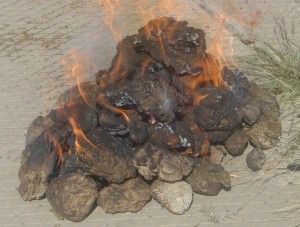
12 You will eat it as [you would] a barley cake and bake it over dried human excrement in their sight." 13 The Lord said, "This is how the Israelites will eat their bread-ceremonially unclean-among the nations where I will banish them." 14 But I said, "Ah, Lord God , I have never been defiled. From my youth until now I have not eaten anything that died naturally or was mauled by wild beasts. And impure meat has never entered my mouth." 15 He replied to me, "Look, I will let you [use] cow dung instead of human excrement, and you can make your bread over that."

Ezekiel is in a real rough patch here.  God is having him do a very elaborate dramatization of the destruction of Jerusalem.  And it's rough, read it, Ezekiel 4.

There has been this idea for a while now, well a dozen centuries or something, among a faction of theology which says everything goes on for a reason and God is in control of everything.  

Romans 9:21 says "Or has the potter no right over His clay, to make from the same lump one piece of pottery for honor and another for dishonor?"  What is Paul saying here?  Is he saying God makes some people to be saved and the rest to be damned?  And then his anger burns against the damned people for being damned even though that's how he made them?

You might think so if you didn't do some deeper research.  Let's do some deeper research.

Paul was well versed in the Old Testament.  As a Pharisee, he probably had the entire Torah memorized and knew major portions of the prophets and Psalms as well.  He would have known what we now call the Old Testament deeply.

So when he brings up a potter and clay analogy, we have to ask, where might he have gotten that?

If we're reading our Bibles once a year (a very good practice) we probably came across that just recently.

1 [This is] the word that came to Jeremiah from the Lord: 2 "Go down at once to the potter's house; there I will reveal My words to you." 3 So I went down to the potter's house, and there he was, working away at the wheel. 4 But the jar that he was making from the clay became flawed in the potter's hand, so he made it into another jar, as it seemed right for him to do. 5 The word of the Lord came to me: 6 "House of Israel, can I not treat you as this potter [treats his clay]?"-[this is] the Lord's declaration. "Just like clay in the potter's hand, so are you in My hand, house of Israel. 7 At one moment I might announce concerning a nation or a kingdom that I will uproot, tear down, and destroy [it]. 8 However, if that nation I have made an announcement about, turns from its evil, I will not bring the disaster on it I had planned. 9 At [another] time I announce that I will build and plant a nation or a kingdom. 10 However, if it does what is evil in My sight by not listening to My voice, I will not bring the good I had said I would do to it. 11 So now, say to the men of Judah and to the residents of Jerusalem: This is what the Lord says: I am about to bring harm to you and make plans against you. Turn now, each from your evil way, and correct your ways and your deeds. 12 But they will say: It's hopeless. We will continue to follow our plans, and each of us will continue to act according to the stubbornness of his evil heart." 

There you have it.  It's a different sort of a picture isn't it?  It's not God making some people to be saved and some to be damned, the damned ones are that way because they choose to be.  God even warns Israel to pay attention because he might preach damnation against some nation but then the nation decides to repent and God will repent of his pronouncements as well.  A prime example of this was the city of Nineveh in the book of Jonah.  Jonah was sent to preach the destruction of Nineveh and Jonah was truly a prophet of God, and yet his pronouncement did not come to pass because the people repented

Back to the clay.  We can see here that the clay has a say in how it's made, and we can see it with Ezekiel as well.  The clay didn't want to be a jar so the potter made something else with it.  God gave Ezekiel a command, something to do that was very nasty, would make him unclean, and may have even been sinful and he didn't want to do it.  So God relents of his pronouncement and let's him do something a little less nasty.  Did it make as big a point as it could have?  Probably not.  But so it seems, the clay gets a say.  

Monday, March 22, 2010

The Calvinist's Guide to Global Warming

I was having a Facebook flame out the other day in the comments section of a Status Update which said and I quote "IN YOUR FACE GLOBAL WARMING FREAKS" in response to a snow storm on the first day of spring.  Now I like to get into a few Facebook flameouts because as you know, Facebook is my b!tch and I like to bait people and see if I can get them to do stuff like what I'm about to write to you about.


So, the guy(who posted the status)'s mother comes on (and let me say, I like this family, and know them pretty well, but they are such staunch conservatives) and leaves the following tirade:


It's quite presumptuous to think that mere men can affect the Sovereign God's world to such a degree. God has CHOSEN to consider us eternally valuable--our significance is not innate. He will bring us down when we begin to talk like the Babel-onians :), whose pride caused them to set themselves up against an omnipotent, Creator God. Seems that the most serious impending danger lies in our moral depravity...not in our "poor stewardship" of the earth. What are your hearts like? Jesus spent His time exposing the true motives and conditions of His friends' hearts. So~with what are you filling your minds?...and eyes? and ears? What are you eating, drinking, or smoking? It is much easier to live from the outside, in, rather than from the inside, out.

God will destroy His earth, whenever He is ready. We're not that powerful.

Name-calling is inappropriate, weakens your case. Confirms the assertion than the liberal platform resorts to attacking the person, rather than stating the (known) facts.... See More

Environmentalism is a works-based righteousness religion. It borders on idolatry, gives us reasons to pat ourselves on the backs. Don't impose it on me.

American industry should behave responsibly, certainly. But China and India are some of the greatest offenders---yet the U.S. continues her martyr-like, self-punitive behaviors. (Beijing Summer Olympics 2008....and Ganges River)

Freedom>>prosperity>>jealous neighbors, who don't want our "freedom tactics" to leak out, or they'll lose power>>"U.S. is evil!!!" (= we hate them because they're prosperous)


I replied "with all due respect, that's your interpretation" because I didn't want to start a fight with her, because middle aged people in no way get what I'm doing on Facebook.  So I thought, for the benefit of those who may read this blog, that I'd explore the tirade and relate what's wrong with it, bibilcally, politically, factually, and spasmodically.

The first sentence is self defeating if you look at it long enough.  Why then is it not quite presumptuous to think that mere men can not affect the Sovereign God's world to such a degree?  Is it presumptuous to presume that I may be able to shoot someone against God's will?  And if God plans on burning the thing up anyway, (depending on your interpretation) why would we not be able to do our own fair bit to destroy it before then?  Simply saying that we are too small to make a difference does not make it so, there are nearing seven billion of us.  That's 13 people per square kilometer and 47 people per square kilometer of land or one person for every 21,277 square meters.  I don't know about you, but give me a few years, and I could tear up a 21,277 square meters if I wanted to.  That's only about five acres, I got two acres now!

And then the stuff about the Babylonians.  Am I to believe that by supporting initiatives against the destruction of the environment, I am going against God?  I believe the good book says that when God created this joint, he called it "very good." His plan of restoration is to fix what we have messed up.  The word often translated "dominion" in Genesis is better understood as borrowed or held in trust as in the parable of the talents in the new testament.

The name calling wasn't me, it was someone else.

Call environmentalism what you want, but it goes back to name calling.  And if environmentalism is a religion, so is anti-environmentalism.  And as far as imposition goes, don't impose your non caring attitude and politics on me.

If the US needs to be disciplined due to its actions, so be it.  You tell you children things like "just because everyone is doing it doesn't mean you should do it," but on a national scale, I guess the ideology changes. 

And finally, the last paragraph takes the cake.  The hubris and bigotry is self evident.  The world doesn't hate us because we are prosperous, they hate us because we keep BOMBING THEIR VILLAGES!!!  And we do it in Jesus name, at least in their eyes.

I'm not in favor of protecting the environment because of some self serving pseudo religious idolatrous fervor.  I protect the environment because what you do with a gift depends on what you believe about the giver.  I love the giver, why would I not cherish the gift?  But there's this idea that God has everything under his thumb, not simply under his control, but under his thumb, that he will cause and uncause things to happen and make things go his way.  This is ignorance on the highest level.  It is more than obvious that God is not running this show.  He works in smaller more intricate ways on individual levels.  But he always allows the morons of the world to do whatever they want for a time. 

Americans are an individualistic riotous revolutionary bunch.  This is what happens when a nation starts through a revolution.  It's like hiring a worship leader who initiated a church split at a previous church.  Understand it or not, we are all here in this joint together.  A more collective goal as a people is necessary.  If you want to be a rugged individualist, please move to Wyoming.

WiredForStereo

Tuesday, January 22, 2008

Calvinism vs. Arminianism and Why We Shouldn’t Pledge Allegiance to Stuff Like This.


I was talking to my friend’s girlfriend about the book “The Shack” by William P. Young, and she said she hadn’t read it because from what she had heard, she thought she’d disagree with at least some of its points. Of course she’ll probably be reading this at some point, so I’ll just say that she’s a very strong Calvinist, as is at least some of her family from what I’ve heard. She’s a very bright girl, and definitely believes what she says she believes, but I kind of get the feeling like she’s one of those brutal Calvinists, which is to say, those who see God as kind of hard and strict. At the very least, I’d like to introduce her to “kind Calvinism” as Mark Driscoll would call it. So, I decided what I’d do is just to go through both Calvinism and Arminianism and see what they both mean, and offer my insights on both.

For those of you who know me, you may know that I do not adhere to models, which is to say I am not an adherent to things with titles such as Calvinism, Arminianism, Trinitarianism, Arianism, Veganism, Conservatism, Liberalism, Preterism, Dispensationalism, Mormonism, Racism, Sexism, or most other isms excepting Monotheism. The reason is this: Formulaic models often glaze over truth in order to make a text agree with a presupposed belief. The tenets of some of those isms I do believe in, especially some more than others, but I would not say that I adhere to any of them because they are models, and I believe God as bigger than human doctrinal constructs. I do not believe that we can in any way confine or define God to single words whose meanings change with time. Like I said, I do believe in Monotheism, because I believe that eternally, infinitely, and unequivocally, there is only one God, and his singular singularity can be defined in our language by the word Monotheism.

Let me start by saying that this argument is entirely an in house argument. I mean that whether you are a Calvinist or Arminian, as long as you are a Jesus Freak, you are still ok with me, and I assume with Jesus as well. I’ll be quoting Wikipedia quite a bit as a source of definitions and for general information, and I won’t use quotation marks unless Wikipedia does because of the unknown authorship or the original article anyway. I’ll start with Arminianism which is still quite popular among popular and well known preachers and evangelists, and I’ll basically be stating each belief and my view on it, and why. It should be noted that Calvinism’s five points were created not by John Calvin himself, but later by people concerned with countering five points outlined at the Synod of Dort by Arminians. Arminius was born 4 years before Calvin died and died 100 years after Calvin was born. The Synod of Dort happened a year after Arminius died in 1609. In actuality, today Arminianism does not have five points anymore, and has reverted to what Jacobus Arminius believed which actually has a bit in common with Calvinism. Some may be actually surprised to learn that Calvinism and Arminianism are not directly opposed, but are like the two circles on a MasterCard. They have overlapping belief systems.

Arminianism

1. Humans are naturally unable to make any effort towards salvation.

I’d say true to a point, and that point being God’s call. However before the rabid Calvinists jump on that one, I believe that all are called just like the Bible says. In the literal sense, ALL are called. Jesus wishes all to be saved but naturally, many will not because they will not reciprocate his love.

2. Salvation is possible by grace alone.

Absolutely agree, however, it should be easy to spot believers and unbelievers based on speech and actions, not just what they say and do in public. I have known a number of worship leaders who said and did all sorts of things in public and wrote wonderful worship songs, but in private, to the discerning eye, they were at least questionable. So, salvation is by grace alone and is evidenced by love and works.

3. Works of human effort cannot cause or contribute to salvation

Yes, see above. This one belongs to Calvinism too.

4. God's election is conditional on faith in Jesus.

Election is a big big word in Calvinism, and this one can be taken several ways. Jesus said “I am the way, the truth and the life, and no one comes to the father but by me.” Salvation is certainly conditional on faith in Jesus, if you are a Christian, this one is probably pretty close to number one on the list of essentials. However, election is a touchy subject and since God knows the future, you have to decide whether He decides whether you have faith in Jesus, or whether you decide, or whether he draws you to decide, or completely outside any choice of your own, he gives you faith in Jesus. I think an infinitely Just God draws you and gives you a choice, I don't think it's "Duck, Duck, Damned."

5. Jesus' atonement was for all people.

Here’s another separation from Calvinism. One of the creeds says that Jesus sacrifice was once and for all. Though I don’t hold to any creeds, I agree with this. I believe that Jesus died for everyone, whether or not they chose to play that card at the judgment. I believe every sin committed in the history of the universe weighed on his shoulders on the cross.

6. God allows his grace to be resisted by those unwilling to believe.

Naturally. While humans may be unable to understand the pure infinity of knowing the future and yet not making it happen, I believe God can. In the same way, I believe God can create an entirely autonomous being with perfect free will, but not with infinite free will as God has. Of course God is all powerful and if he wished, he could cause anyone to do anything, but he doesn’t do anything as far as salvation goes that we do not want. He merely ratifies our choices, if we seek him, we will find him, if we choose not to seek him, then he merely ratifies our choice of damnation.

7. Salvation can be lost, as continued salvation is conditional upon continued faith

I do not agree with this in the sense that you can lose your salvation. I do believe you can leave it. I don’t believe that a person can get saved and then live out the rest of their life with no consideration of Jesus whatsoever and stay saved. I would submit that they never knew Jesus to begin with. God does know the end from the beginning, and he can see all the future, and if a person becomes backslidden or loses the faith for a while or multiple times but returns, God knew it would happen.

Calvinism is a bit different, perhaps more popular, and definitely more defined and structured, as a Calvinistic God would seem to be. Calvinism usually has five points, often denoted with the acronym TULIP. The five points were not created by Calvin, who more simply believed that God was in all things infinitely sovereign, but created in response to Arminius’ followers’, Remonstrants as they were called, 5 points. The Remonstrants actually opposed the doctrine of Total Depravity even though Arminius and Wesley affirmed it, but they just wanted to be opposed to Calvinism I guess.

Calvinism

1. Total depravity

This one is basically the same as #1 above.

2. Unconditional election asserts that God's choice from eternity of those whom he will bring to himself is not based on foreseen virtue, merit, or faith in those people. Rather, it is unconditionally grounded in God's mercy alone.

I would disagree based on the verse that says “those he foreknew, he also predestined.” Now what that means, I cannot say for sure. But I cannot accept the assertion that foreknew means something other than he knew before as I heard Driscoll put it today from last Sunday’s sermon. He said something like God reached out in love, and that’s what foreknew meant, but it is obvious to me that the word simply means that he knew ahead of time. I do believe the part of salvation being in God’s mercy alone, but with the context of God wanting to grant mercy to everyone. He would not have died if he did not want to grant mercy.

3. Limited atonement is the teaching that Jesus' substitutionary atonement was definite and certain in its design and accomplishment. Calvinists view the atonement as a penal substitution (that is, Jesus was punished in the place of sinners), and since, Calvinists argue, it would be unjust for God to pay the penalty for some people's sins and then still condemn them for those sins, all those whose sins were atoned for must necessarily be saved. Moreover, since in this scheme God knows precisely who the elect are and since only the elect will be saved, there is no requirement that Christ atone for sins in general, only for those of the elect.

This I mentioned up in the Arminianism section. Christ died for everyone; all sin was upon him. It leaves no room for question if anyone is elect or not, if you want Jesus, he is available. What if someone sneaks in who wasn’t elect? Then Jesus would have to go back and die again for that guy. I know it wouldn’t happen, but it serves to frame the argument. I don’t think injustice even enters the argument here for one simple reason. Jesus took upon himself our sin, there is no justice in that. There is mercy and love.

4. The doctrine of irresistible grace (also called "efficacious grace") asserts that the saving grace of God is effectually applied to those whom he has determined to save (that is, the elect) and, in God's timing, overcomes their resistance to obeying the call of the gospel, bringing them to a saving faith. The doctrine does not hold that every influence of God's Holy Spirit cannot be resisted but that the Holy Spirit is able to overcome all resistance and make his influence irresistible and effective. Thus, when God sovereignly purposes to save someone, that individual certainly will be saved.

I don’t really buy this because I don’t think God would directly save someone against his will. Heaven for a demon is like hell to a Jesus Freak. This goes back to the foreknowledge and predestination stuff. It would seem that God would look down in time, see those who would be saved with the right impetus, then provides that impetus. Of course, outside of that provision, no one would even want to be saved. I do believe that it is well within God’s power to overcome any resistance to his will, like he can overcome gravity or whatever, the simple question is “does he?”

5. Perseverance (or preservation) of the saints is also known as "eternal security." The doctrine asserts that, since God is sovereign and his will cannot be frustrated by humans or anything else, those whom God has called into communion with himself will continue in faith until the end. Those who apparently fall away either never had true faith to begin with or will return. This doctrine is slightly different from the Free Grace or "once saved, always saved" view advocated by some evangelicals in which, despite apostasy or unrepentant and habitual sin, the individual is truly saved if he or she had truly accepted Christ at any point in the past. In traditional Calvinist teaching, apostasy by such a person may be proof that they never were saved.

I am ok with this one as long as it does not include the “once saved, always saved” view. Again, God knows all future, and he knows if we fall away if we will return or not. My father is a pretty heavy Arminian and would ask the question if someone were saved and falls away, if they died while they were saved, would they go to heaven? I really think that is up to God, he knows the heart. I do believe God is irresistible when he wants to be, but he has purposed freedom of choice as a part of being created in his image. I believe he designed a perfect system in which his creations could choose Him or choose otherwise.

Calvinism as a kind of racism.

Something that bothers me about Calvinism is the whole election thing. It ends up being a kind of racism, something you are endowed by God with that makes you better than people who are not, just like white skin has for so much of history. The problem is, unlike being white, a person does not really know if they are elect. They never know if they may fall away at some future time and it turns out that they were never really saved at all. Even worse is when they argue with you. They can sometimes have an air of “I’m elect, and if you are arguing with me, you obviously aren’t.” I do not like classes, especially among believers. *I just thought of something after I posted this. Since you in reality don't really know if you are elect, that means you don't really know you are saved, and if you don't know that, then you are worse off than an Arminian who has assurance of salvation as long as he stays a believer. So pure Calvinism and Election both effectively remove assurance of salvation because you can't really know if you are elect unless you can read God's mind, and if you should happen not to be elect, then you are not saved no matter what you do. So instead of a salvation based on works where you don't know if you've done enough good in say Islam or Catholicism, you now have Salvation based on having faith that you will always be a believer, which is Arminianism. Did I just disprove Calvinism altogether? Interesting.

Overall, I must again stress that I do not hold onto models because they often need to play fast and loose with interpretation to make their stuff fit. The original Arminians simply came up with their five points to counter the prevailing Calvinism, and the Five Points of Calvinism were a response to the five points of the Synod of Dort Arminians. A belief system should never be made up of a list of things we don’t do or believe in, that’s not how Jesus worked. Jesus was all about the do’s. Care for the poor, forgive, be humble, love God, love others, have faith, be faithful, take heart, give generously, and believe in me were his commands.

So I’m like a two and a half point Calvinist, and a five and a half point Arminian.

WiredForStereo