Thursday, September 9, 2010
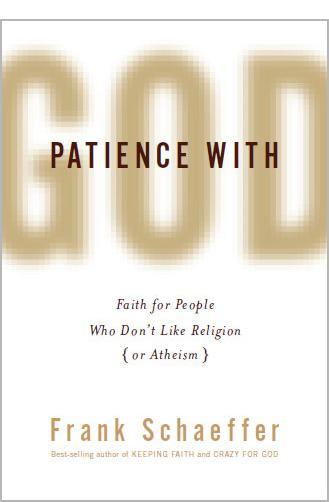
Book Review: "Patience with God: Faith for People who Don't Like Religion {or Atheism}" by Frank Schaeffer
Later in the book where he focuses more on his backstory and history and philosophy, the salient points are further between, but Frank is a good writer, and if he doesn't expand your vocabulary, you're probably an english major. Unlike other books where I feel like the author was writing to a ninth grader, Frank keeps it more up to my level.
I heartily recommend this book especially if like me, you're searching for not just something to believe in but the best and most truthful something to believe in. And I don't mean truth in a "We have the truth, join us" sort of way, but a level headed look at the real factual truth, the truth that God is not the god of the fundamentalists, or the right wing, but the creator and redeemer of our planet.
I don't recommend reading Schaeffer's book to believe everything that's in it, but rather to read it to glean information and ideas from it. Schaeffer takes an even more liberal and cynical view of religion than I do, and if you read his Huffington Post articles, you'll find that. At times he can even be a bit overly hostile especially toward the Older Testament. But he has a very interesing and eye opening point of view.
If you plan to read this book, I suggest you read "Crazy for God" first as this book may seem to build upon it in a few places. They were written in that order, so it only makes sense to read them in that order.
9/10
WiredForStereo
Wednesday, June 13, 2007
The Fundamentals of Fundamentalists
Wikipedia says:
Christian fundamentalism: A movement that arose mainly within British and American Protestantism in the late 19th and early 20th centuries by evangelical Christians, who, in a reaction to Modernism, actively affirmed a fundamental set of Christian beliefs: the inerrancy of the Bible, Sola Scriptura, the virgin birth of Christ, the doctrine of substitutionary atonement, the bodily resurrection of Jesus, and the imminent return of Jesus Christ.
So, let's compare the definition with the group, but first, what are the real fundamentals of the Christian Faith? Think for a second. I think we could consider a subject that is mentioned more often than others in the Bible a fundamental don't you? Ok, what is mentioned most in the Bible? Is it the inerrancy of the Bible? No, I don't think that's in there. Is it Sola Scriptura? No, the Bible even quotes other books. Is it the Virgin Birth of Christ? A few times, but still no. Is it the doctrine of Substitutionary Atonement? More times but still no. Is it the bodily resurrection of Christ? Closer, but no. Finally, is it the imminent return of Jesus Christ? No, money is still mentioned more than that.
So what is it?
What is mentioned more than anything in the New Testament, and comes in second in the Old Testament? Simple. Poverty. What? No, surely not, you mean it's not abortion or gay marriage or immigration or even Islam? Number one in the Old Testament is idolatry by the way.
Poverty. Poverty is mentioned over 2000 times in the Bible.
So we have a case here of missing the fundamentals by the Fundamentalists. How ironic, don't you think? A political party that claims a monopoly on Christianity and Faith, yet seems to be pro war, pro rich, and only pro American to quote Jim Wallis.
Other reasons I am not a fundamentalist are the first two on the list under the definition, inerrancy of the Bible, and Sola Scriptura. First I'd like to say that the "Word of God" is inerrant. But the Bible is not so much the Word of God as the Word of God and some history according to a number of authors. This is why we have the "Gospel According to ..." not "God's Inerrant Word About Some Stuff That Happened." Was there one Gerasene Demoniac or two? Don't let me discourage you however. The Bible contains the inerrant Word of God, but the whole thing isn't the whole of the inerrant Word of God. This leads me to the second point. Sola Scriptura was created in response to people trying to add onto the scriptures. However, I believe in Sola Scripture insofar as it does not preclude the inspiration of the Holy Spirit. And of course as the Bible says, spirits must be tested in light of scripture.
So what's the message here? The prime fundamental of the Christian Faith should be Jesus' work on the cross, because without that, there is nothing else, but then care for the poor, you know, widows and orphans, and then we can add all those other things. Because after all, if we are not following God's most mentioned command, what's the point of trying to pretend we are following the rest?
Inspired,
WiredForStereo
