I had to get a little chuckle out of this.
Sunday, October 6, 2013
Isn't God no Better than the Flying Spaghetti Monster? or a 'Special Com...
I had to get a little chuckle out of this.


The Clay Gets a Say
Here's a nifty little passage I read the other day:
12 You will eat it as [you would] a barley cake and bake it over dried human excrement in their sight." 13 The Lord said, "This is how the Israelites will eat their bread-ceremonially unclean-among the nations where I will banish them." 14 But I said, "Ah, Lord God , I have never been defiled. From my youth until now I have not eaten anything that died naturally or was mauled by wild beasts. And impure meat has never entered my mouth." 15 He replied to me, "Look, I will let you [use] cow dung instead of human excrement, and you can make your bread over that."
Ezekiel is in a real rough patch here. God is having him do a very elaborate dramatization of the destruction of Jerusalem. And it's rough, read it, Ezekiel 4.
There has been this idea for a while now, well a dozen centuries or something, among a faction of theology which says everything goes on for a reason and God is in control of everything.
Romans 9:21 says "Or has the potter no right over His clay, to make from the same lump one piece of pottery for honor and another for dishonor?" What is Paul saying here? Is he saying God makes some people to be saved and the rest to be damned? And then his anger burns against the damned people for being damned even though that's how he made them?
You might think so if you didn't do some deeper research. Let's do some deeper research.
Paul was well versed in the Old Testament. As a Pharisee, he probably had the entire Torah memorized and knew major portions of the prophets and Psalms as well. He would have known what we now call the Old Testament deeply.
So when he brings up a potter and clay analogy, we have to ask, where might he have gotten that?
If we're reading our Bibles once a year (a very good practice) we probably came across that just recently.
1 [This is] the word that came to Jeremiah from the Lord: 2 "Go down at once to the potter's house; there I will reveal My words to you." 3 So I went down to the potter's house, and there he was, working away at the wheel. 4 But the jar that he was making from the clay became flawed in the potter's hand, so he made it into another jar, as it seemed right for him to do. 5 The word of the Lord came to me: 6 "House of Israel, can I not treat you as this potter [treats his clay]?"-[this is] the Lord's declaration. "Just like clay in the potter's hand, so are you in My hand, house of Israel. 7 At one moment I might announce concerning a nation or a kingdom that I will uproot, tear down, and destroy [it]. 8 However, if that nation I have made an announcement about, turns from its evil, I will not bring the disaster on it I had planned. 9 At [another] time I announce that I will build and plant a nation or a kingdom. 10 However, if it does what is evil in My sight by not listening to My voice, I will not bring the good I had said I would do to it. 11 So now, say to the men of Judah and to the residents of Jerusalem: This is what the Lord says: I am about to bring harm to you and make plans against you. Turn now, each from your evil way, and correct your ways and your deeds. 12 But they will say: It's hopeless. We will continue to follow our plans, and each of us will continue to act according to the stubbornness of his evil heart."
There you have it. It's a different sort of a picture isn't it? It's not God making some people to be saved and some to be damned, the damned ones are that way because they choose to be. God even warns Israel to pay attention because he might preach damnation against some nation but then the nation decides to repent and God will repent of his pronouncements as well. A prime example of this was the city of Nineveh in the book of Jonah. Jonah was sent to preach the destruction of Nineveh and Jonah was truly a prophet of God, and yet his pronouncement did not come to pass because the people repented
Back to the clay. We can see here that the clay has a say in how it's made, and we can see it with Ezekiel as well. The clay didn't want to be a jar so the potter made something else with it. God gave Ezekiel a command, something to do that was very nasty, would make him unclean, and may have even been sinful and he didn't want to do it. So God relents of his pronouncement and let's him do something a little less nasty. Did it make as big a point as it could have? Probably not. But so it seems, the clay gets a say.

12 You will eat it as [you would] a barley cake and bake it over dried human excrement in their sight." 13 The Lord said, "This is how the Israelites will eat their bread-ceremonially unclean-among the nations where I will banish them." 14 But I said, "Ah, Lord God , I have never been defiled. From my youth until now I have not eaten anything that died naturally or was mauled by wild beasts. And impure meat has never entered my mouth." 15 He replied to me, "Look, I will let you [use] cow dung instead of human excrement, and you can make your bread over that."
Ezekiel is in a real rough patch here. God is having him do a very elaborate dramatization of the destruction of Jerusalem. And it's rough, read it, Ezekiel 4.
There has been this idea for a while now, well a dozen centuries or something, among a faction of theology which says everything goes on for a reason and God is in control of everything.
Romans 9:21 says "Or has the potter no right over His clay, to make from the same lump one piece of pottery for honor and another for dishonor?" What is Paul saying here? Is he saying God makes some people to be saved and the rest to be damned? And then his anger burns against the damned people for being damned even though that's how he made them?
You might think so if you didn't do some deeper research. Let's do some deeper research.
Paul was well versed in the Old Testament. As a Pharisee, he probably had the entire Torah memorized and knew major portions of the prophets and Psalms as well. He would have known what we now call the Old Testament deeply.
So when he brings up a potter and clay analogy, we have to ask, where might he have gotten that?
If we're reading our Bibles once a year (a very good practice) we probably came across that just recently.
1 [This is] the word that came to Jeremiah from the Lord: 2 "Go down at once to the potter's house; there I will reveal My words to you." 3 So I went down to the potter's house, and there he was, working away at the wheel. 4 But the jar that he was making from the clay became flawed in the potter's hand, so he made it into another jar, as it seemed right for him to do. 5 The word of the Lord came to me: 6 "House of Israel, can I not treat you as this potter [treats his clay]?"-[this is] the Lord's declaration. "Just like clay in the potter's hand, so are you in My hand, house of Israel. 7 At one moment I might announce concerning a nation or a kingdom that I will uproot, tear down, and destroy [it]. 8 However, if that nation I have made an announcement about, turns from its evil, I will not bring the disaster on it I had planned. 9 At [another] time I announce that I will build and plant a nation or a kingdom. 10 However, if it does what is evil in My sight by not listening to My voice, I will not bring the good I had said I would do to it. 11 So now, say to the men of Judah and to the residents of Jerusalem: This is what the Lord says: I am about to bring harm to you and make plans against you. Turn now, each from your evil way, and correct your ways and your deeds. 12 But they will say: It's hopeless. We will continue to follow our plans, and each of us will continue to act according to the stubbornness of his evil heart."
There you have it. It's a different sort of a picture isn't it? It's not God making some people to be saved and some to be damned, the damned ones are that way because they choose to be. God even warns Israel to pay attention because he might preach damnation against some nation but then the nation decides to repent and God will repent of his pronouncements as well. A prime example of this was the city of Nineveh in the book of Jonah. Jonah was sent to preach the destruction of Nineveh and Jonah was truly a prophet of God, and yet his pronouncement did not come to pass because the people repented
Back to the clay. We can see here that the clay has a say in how it's made, and we can see it with Ezekiel as well. The clay didn't want to be a jar so the potter made something else with it. God gave Ezekiel a command, something to do that was very nasty, would make him unclean, and may have even been sinful and he didn't want to do it. So God relents of his pronouncement and let's him do something a little less nasty. Did it make as big a point as it could have? Probably not. But so it seems, the clay gets a say.
Trying Out the Holman Christian Standard Bible
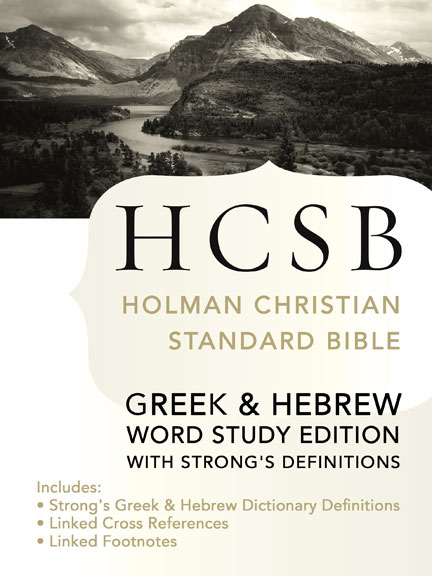
When I first
began reading the Bible in earnest, I used the NIV (New International
Version). The NIV is a very good
translation. It took a lot of criticism
in the beginning, largely I believe, because it was such a break from the then
tradition of biblical translation.
However, it’s been a number of decades and a lot of the KJV (King James
Version) Only crowd have died off. Many
many more translations have been produced and the NIV has more or less fallen
out of the popular spotlight though it is still quite popular. Anyway, that’s the one I read at the time. Using that Bible, I read through the New
Testament a handful of times and the minor prophets and a few other Old
Testament books here and there.
Then I heard
about the ESV (English Standard Version).
It gained some sexiness in the mid 20-oughts. Add to that, the Crossway covers (very sexy)
and that was the first Bible I bought.
They had a free Kindle version too, which was nice. Mark Driscoll also endorsed it along with a
number of the Calvinist crowd. But
reading through the Bible, I started noticing some liberties being taken,
especially in numerology. People do
complain about versions and the conversion of the word “man” to “people” but
that’s not really what I’m after. What I
started noticing was that certain phrases or words were translated in ways
other than the original text warranted.
It was things like in Exodus 20:6 where it says “showing steadfast love
to thousands of those who love me.”
In the foot notes it says “or to the thousandth generation.” A simple interpretation of a thought, yes,
but when you mess with numbers in the Bible, you are missing with contextual
meanings. Can’t do that. “Thousand” is used a number of times in the
Bible and
specific meaning can be drawn from its usage.
Compare the HCSB: “but
showing faithful love to a thousand [generations] of those who love Me.”
These make interpretations too, but they keep the terminology
and they demonstrate what they’re doing while they’re doing it. No footnotes.
Well, the NIV left out steadfast/faithful.
Another problem I have with many modern translations of the
Bible is the traditional lack of translation of God’s personal name in the
text. Of course anybody reading the text
knows that LORD means YHVH, the Hebrew transliteration of God’s name, so God’s
name has not been “left out,” just left untranslated for tradition sake. Virtually all scholars agree that the correct
pronunciation of the tetragrammaton (four letter name) of God is Yahweh or Yah’weh. But few translations of the Bible do.
So I started reading LORD as Yahweh in my own personal
reading. The thing is, the name is used
A LOT, over 6000 times in the Old Testament.
But I was still reading the ESV, a version I knew had problems I didn’t
like.
I had been told about the Holman Christian Standard Bible a
while back by a Jehovah’s Witness or two.
They use the name Jehovah (a bastardized and Anglicized version of God’s
name) profusely and stick it in everywhere in the OT and everywhere they feel
it necessary to excise Jesus’ divinity in the New Testament. Naturally, I distrusted anything coming from
a JW. They are after all perhaps the
most well-known dangerous mind control cult.
But I came upon the HCSB on my own one day when researching the name
Yahweh.
The HCSB uses
Yahweh when the name of God is stated in the Hebrew. For instance, if the author says something
like “our God, whose name is the LORD” it doesn’t really make much sense in
English. It’s like “they call me the
Doctor!” “Doctor who?” “Exactly.”
Well, fun, but not useful. It
would seem to me a better translation would be “our God, whose name is Yahweh.” Now you know what we’re talking about.
The HCSB
still uses LORD pretty regularly. They only
use Yahweh a few more than one in ten times.
But remember, the name is in there over 6000 times. That’s like eight times per page.
So after
reading virtually all the Bible in NIV, and again in ESV, now I’m reading the
HCSB. Of course I still have access to
every version available on various Bible apps, and my personal copies of the
ESB, NIV, NASB, and even the Greek NT. I
can’t wait to get back to the New Testament to see how the HCSB translates
those.
Tuesday, October 1, 2013
Love Your Enemy 3: Forgive
Forgiveness is hard.
Here's something for you to think about. Why couldn't God just forgive sin? Why did anybody have to die about it? Couldn't God just forgive it and it be over with?
Maybe. Or maybe such a question comes from a misunderstanding of forgiveness.
Forgiveness costs. In an ultimate sense, it costs. Say you stole something, five dollars from your friend. To forgive you, that friend has to incur the cost of five dollars. It cost that person five dollars to forgive you. That person cannot just forgive you and not have to eat that five dollars.
God is the same way. God is forgiving, but God is also just. If God were to forgive you without incurring that cost, he would sacrifice his justice for the sake of his forgiveness. But he is just and he is forgiving at the same time. So he pays the price so that his justice and his mercy are fulfilled at the same time.
Forgiveness for you is the same way. You can't "just let it go." It hurts you to forgive, even if you don't realize it immediately. Jesus said if someone asks for forgiveness seventy times seven times, we should forgive. He was probably being facetious, but I think it's obvious we should always forgive. And maybe that means we become people of sorrows, just as he was.
But the joy comes in the morning.
When teaching his disciples to pray, Jesus said "forgive our sins as we forgive those who sin against us." In forgiveness, we release the other person to collect their ultimate dues and we don't drag ourselves down with them. Unforgiveness is like eating poison and expecting the other person to die.
Here's something for you to think about. Why couldn't God just forgive sin? Why did anybody have to die about it? Couldn't God just forgive it and it be over with?
Maybe. Or maybe such a question comes from a misunderstanding of forgiveness.
Forgiveness costs. In an ultimate sense, it costs. Say you stole something, five dollars from your friend. To forgive you, that friend has to incur the cost of five dollars. It cost that person five dollars to forgive you. That person cannot just forgive you and not have to eat that five dollars.
God is the same way. God is forgiving, but God is also just. If God were to forgive you without incurring that cost, he would sacrifice his justice for the sake of his forgiveness. But he is just and he is forgiving at the same time. So he pays the price so that his justice and his mercy are fulfilled at the same time.
Forgiveness for you is the same way. You can't "just let it go." It hurts you to forgive, even if you don't realize it immediately. Jesus said if someone asks for forgiveness seventy times seven times, we should forgive. He was probably being facetious, but I think it's obvious we should always forgive. And maybe that means we become people of sorrows, just as he was.
But the joy comes in the morning.
When teaching his disciples to pray, Jesus said "forgive our sins as we forgive those who sin against us." In forgiveness, we release the other person to collect their ultimate dues and we don't drag ourselves down with them. Unforgiveness is like eating poison and expecting the other person to die.
Love Your Enemy 2: Identify With Your Enemy
One of the biggest blocks to spreading the gospel is an "us" and "them" mentality.
In their apology against Christianity, I often see atheists and others pointing out that labeling people as "unbelievers" puts them in a class that is easily disparaged and discriminated against. This is true....if Christianity were a set of logical propositions to be accepted or rejected based on their ability to describe the natural world.
But it isn't.
Well for quite a few people it is. Many people accept Christianity because it's cultural. They've always been christians. Their parents are christians. They are patriots and say the pledge of allegiance proudly at the [insert sport here] game and argue that there is a war on Christmas. They think church is something we do for an hour and a half on Sunday or the building we do it in.
But it isn't.
Christianity is based around the person of Jesus the Messiah, the Son of God. If you haven't met him, if you don't know him, you aren't a Christian no matter how many times you've gone to church rather than doing something you'd enjoy more. Jesus calls this being "born again." He said you have to be born again. In Matthew, there's a story about people who get to the judgment and wonder why they're not in. Jesus says "I never knew you."
So what does this have to do with your enemy?
Because if you are born again, you have no enemies. You can see through the eyes of others. You see your sin as the most important thing for you to work on and not everybody else's. You worry about controlling your own eyes rather than trying to censor television. It is your sin Jesus says you need to be concerned about. He likened it to trying to get a spec out of your friend's eye while you've got a board in yours.
Every person has value and everyone is welcomed by God through Jesus. A real Christian won't treat a non-believer like a second class citizen. We know that there is no one worse than us. The Apostle Paul said "I am the chief of sinners." I'm no better than you. In fact I'm worse. Because following Jesus isn't about being good, it's about being forgiven. And the more you're forgiven, the more you know how truly evil you are.
In their apology against Christianity, I often see atheists and others pointing out that labeling people as "unbelievers" puts them in a class that is easily disparaged and discriminated against. This is true....if Christianity were a set of logical propositions to be accepted or rejected based on their ability to describe the natural world.
But it isn't.
Well for quite a few people it is. Many people accept Christianity because it's cultural. They've always been christians. Their parents are christians. They are patriots and say the pledge of allegiance proudly at the [insert sport here] game and argue that there is a war on Christmas. They think church is something we do for an hour and a half on Sunday or the building we do it in.
But it isn't.
Christianity is based around the person of Jesus the Messiah, the Son of God. If you haven't met him, if you don't know him, you aren't a Christian no matter how many times you've gone to church rather than doing something you'd enjoy more. Jesus calls this being "born again." He said you have to be born again. In Matthew, there's a story about people who get to the judgment and wonder why they're not in. Jesus says "I never knew you."
So what does this have to do with your enemy?
Because if you are born again, you have no enemies. You can see through the eyes of others. You see your sin as the most important thing for you to work on and not everybody else's. You worry about controlling your own eyes rather than trying to censor television. It is your sin Jesus says you need to be concerned about. He likened it to trying to get a spec out of your friend's eye while you've got a board in yours.
Every person has value and everyone is welcomed by God through Jesus. A real Christian won't treat a non-believer like a second class citizen. We know that there is no one worse than us. The Apostle Paul said "I am the chief of sinners." I'm no better than you. In fact I'm worse. Because following Jesus isn't about being good, it's about being forgiven. And the more you're forgiven, the more you know how truly evil you are.
Sunday, February 10, 2013
Book Review: Cross Roads

Some time ago, I read and reviewed The Shack written by W. Paul Young. I was blessed that he found my review and left a comment. I hope he does again, but if not, oh well. He’s a bit busier now that he is a famous published author probably.
I just finished reading Cross Roads last night. Like The Shack, it did not disappoint in enlightenment, and offered some new weirdness.
Don’t get me wrong, weirdness is not bad. I like weirdness. But there was quite a bit of weirdness.
While The Shack offered an experience akin to an expository dream, Crossroads delves more into the realm of spiritual fantasy. The main character Tony spends a good deal of time knocking about in other people’s minds, not just as a silent passenger, but as an active participant in their stories.
As Mr. Young seems to be able to do, this book brought tears to my eyes on several occasions. Once or twice, I wept silently in my bed in the dark where I do most of my reading. He very effectively presents a redemption story, though a worse human being I have rarely heard of. Short of murder and rape, this guy was a really bad guy. Imagine remarrying your ex-wife just so you can divorce her again, stick it in her face, and have the police escort her and your children from your own house which you bought out from under her while throwing her a get the hell out party. This dude was mean. There are other things that I consider even worse, but which I won’t tell you here because it’s a bit of a plot point. He was a bad guy.
But when he suffers an accident and is laying on his death bed, his journey of redemption and salvation begins. It’s the journey of a wicked and broken man finding out that God still loves him no matter how horrible he is.
Paul Young introduces us to Jesus and the Holy Spirit again though this time around the Holy Spirit takes the form of a different woman, a Native American. Papa God doesn’t appear personally, but his presence is felt and spoken of thought Tony’s adventures while his body lay dying.
Jesus and the Holy Spirit live in a land through which Tony travels. Jesus has a run down house and Grandmother (as she is called) lives in a “hovel” which is small and sparsely furnished. But she’s still a good cook. What these homes are supposed to represent is the space in our hearts, the space for which we have provided room for God. I imagine in some spiritual giant’s heart, the homes would be large, well kept, and lavish. But in Tony’s (an effective atheist) heart, only small homes were provided.
Like Paul Young’s last offering, this book provides a resource in dealing with loss. The honest truth about the Bible is that it doesn’t offer much effective therapy for those grieving a loved one, whether that grief be due to death, disease, defect, or defection. We mourn for those who we loved who have died, but we also mourn for those who are taken from us for some other reason, maybe Down’s Syndrome or some other genetic disorder which robs us of our full mental capacity. A parent mourns for the lost opportunities, for lost baseball games, for lost report cards, for lost first words and first steps. And honestly, the Bible doesn’t help us much with those. But sometimes we meet a person who is much more in tune with how to deal with grief, and usually it's because they have grieved. Paul Young is one such person in my eyes.
The overarching message of The Shack to me was “God’s ways are not our ways.” For this book, I’d say it’s something like “I will never leave you.” God is there to comfort, share pain, to love you and to hug you. And he wants to redeem you always. You’ll never reach a point where God gives up on you and leaves you completely even if you push him out completely. He still wants you and he’ll always come back if you’ll have him. Like Mr. Young said in The Shack, God is not just a better version of you.
I really enjoyed this book. I recommend it to anyone. Maybe it won’t keep you glued from the first page to the last and maybe it will, but it tells a story and the story has a lot of feeling and emotion and even meaning. I hope you enjoy it too.
9/10
Subscribe to:
Posts (Atom)