When I first
began reading the Bible in earnest, I used the NIV (New International
Version). The NIV is a very good
translation. It took a lot of criticism
in the beginning, largely I believe, because it was such a break from the then
tradition of biblical translation.
However, it’s been a number of decades and a lot of the KJV (King James
Version) Only crowd have died off. Many
many more translations have been produced and the NIV has more or less fallen
out of the popular spotlight though it is still quite popular. Anyway, that’s the one I read at the time. Using that Bible, I read through the New
Testament a handful of times and the minor prophets and a few other Old
Testament books here and there.
Then I heard
about the ESV (English Standard Version).
It gained some sexiness in the mid 20-oughts. Add to that, the Crossway covers (very sexy)
and that was the first Bible I bought.
They had a free Kindle version too, which was nice. Mark Driscoll also endorsed it along with a
number of the Calvinist crowd. But
reading through the Bible, I started noticing some liberties being taken,
especially in numerology. People do
complain about versions and the conversion of the word “man” to “people” but
that’s not really what I’m after. What I
started noticing was that certain phrases or words were translated in ways
other than the original text warranted.
It was things like in Exodus 20:6 where it says “showing steadfast love
to thousands of those who love me.”
In the foot notes it says “or to the thousandth generation.” A simple interpretation of a thought, yes,
but when you mess with numbers in the Bible, you are missing with contextual
meanings. Can’t do that. “Thousand” is used a number of times in the
Bible and
specific meaning can be drawn from its usage.
Compare the HCSB: “but
showing faithful love to a thousand [generations] of those who love Me.”
These make interpretations too, but they keep the terminology
and they demonstrate what they’re doing while they’re doing it. No footnotes.
Well, the NIV left out steadfast/faithful.
Another problem I have with many modern translations of the
Bible is the traditional lack of translation of God’s personal name in the
text. Of course anybody reading the text
knows that LORD means YHVH, the Hebrew transliteration of God’s name, so God’s
name has not been “left out,” just left untranslated for tradition sake. Virtually all scholars agree that the correct
pronunciation of the tetragrammaton (four letter name) of God is Yahweh or Yah’weh. But few translations of the Bible do.
So I started reading LORD as Yahweh in my own personal
reading. The thing is, the name is used
A LOT, over 6000 times in the Old Testament.
But I was still reading the ESV, a version I knew had problems I didn’t
like.
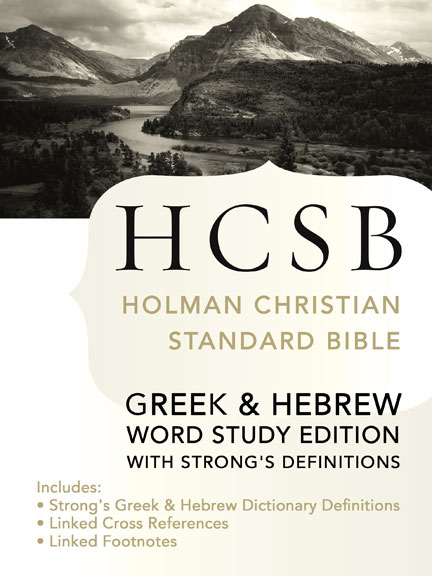
I had been told about the Holman Christian Standard Bible a
while back by a Jehovah’s Witness or two.
They use the name Jehovah (a bastardized and Anglicized version of God’s
name) profusely and stick it in everywhere in the OT and everywhere they feel
it necessary to excise Jesus’ divinity in the New Testament. Naturally, I distrusted anything coming from
a JW. They are after all perhaps the
most well-known dangerous mind control cult.
But I came upon the HCSB on my own one day when researching the name
Yahweh.
The HCSB uses
Yahweh when the name of God is stated in the Hebrew. For instance, if the author says something
like “our God, whose name is the LORD” it doesn’t really make much sense in
English. It’s like “they call me the
Doctor!” “Doctor who?” “Exactly.”
Well, fun, but not useful. It
would seem to me a better translation would be “our God, whose name is Yahweh.” Now you know what we’re talking about.
The HCSB
still uses LORD pretty regularly. They only
use Yahweh a few more than one in ten times.
But remember, the name is in there over 6000 times. That’s like eight times per page.
So after
reading virtually all the Bible in NIV, and again in ESV, now I’m reading the
HCSB. Of course I still have access to
every version available on various Bible apps, and my personal copies of the
ESB, NIV, NASB, and even the Greek NT. I
can’t wait to get back to the New Testament to see how the HCSB translates
those.

